.svg)
.svg)
The upstream opportunity in metals recycling

[.green-heading]Key Takeaways[.green-heading]
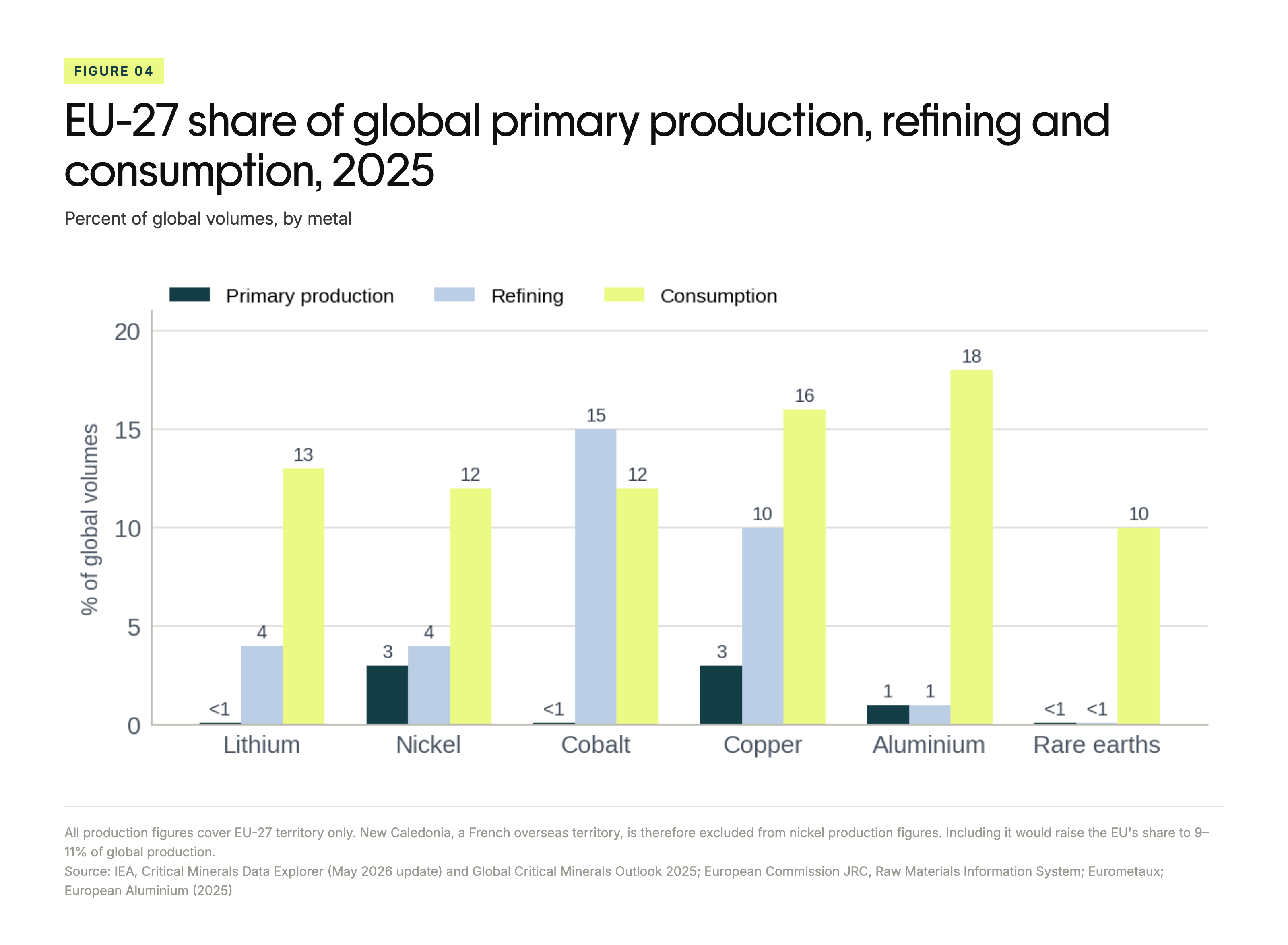
- The EU accounts for 10–18% of global demand for the metals covered in this perspective, but only a few percent of their primary production. With the energy transition and digital transformation set to drive further growth in metal demand, Europe's reliance on external suppliers will become an increasingly important strategic vulnerability
- Europe will need to expand its metal supply through a combination of new mines, material substitution and recycling. New mines take around 16 years on average to move from discovery to first production, although lead times vary considerably by mineral and geography. Recycling is therefore one of Europe's most actionable near-term supply levers, though it cannot close the gap alone. Recovering more metal already circulating in the economy can strengthen domestic supply while reducing emissions by approximately 96% for aluminium and 85% for copper compared with primary production.
- While EU regulation is progressively being rolled out, additional recycling capacity is being developed across Europe. Yet these established and commercially mature recycling processes run up against a feedstock bottleneck. In lithium-ion batteries, existing, announced and planned recycling capacity is projected to exceed available feedstock by approximately three times by 2030. Several major projects have already been delayed or suspended as volumes, commodity prices and costs moved against them.
- The main recovery bottlenecks for end-of-life metals lie upstream of refining. Europe holds substantial quantities of metal in its waste streams, yet too little reaches recyclers in a usable form. SlateVC's illustrative model attributes between 65% and more than 99% of total recovery losses, depending on the feedstock and metal, to collection, dismantling and separation, before material reaches a smelter or refinery.
- The strongest venture opportunities lie in technologies that address specific bottlenecks across the recycling chain, improving recovery rates, material quality and operational efficiency. These solutions can create significant value for recyclers without requiring technology providers to own the materials or operate the plants themselves, as illustrated by recent strategic acquisitions and partnerships.
[.green-box]Section 01[.green-box]
Europe runs on metals it does not control
Global metal demand has risen for more than a century, driven by population growth, industrialization and rising incomes. Since 1900, the world’s population has grown about fivefold and average real incomes have increased seven- to eightfold.[1] As economies have developed and urbanized, demand has grown for metal-intensive infrastructure and equipment, from roads and power grids to vehicles, appliances and electronics.
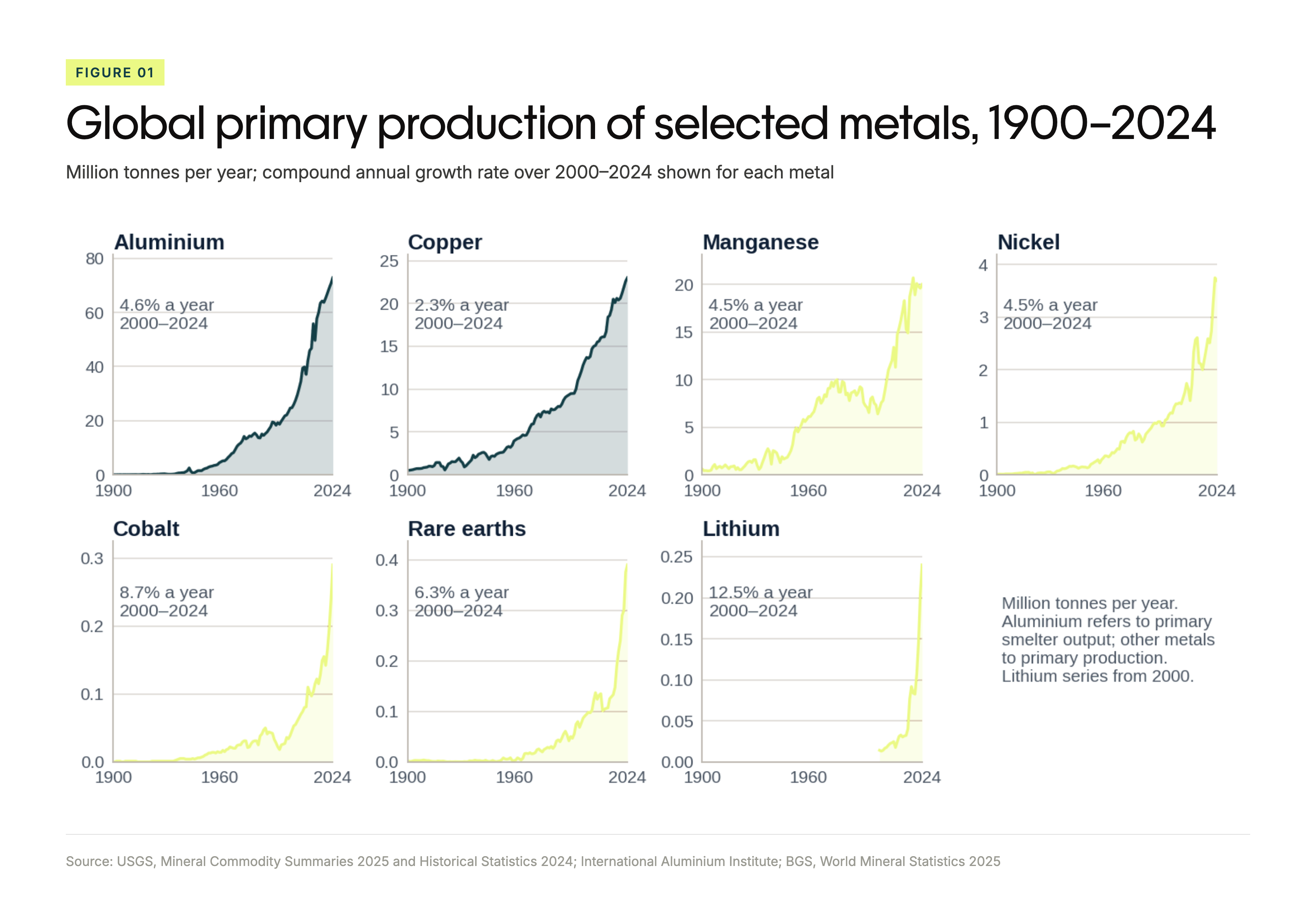
Over the past quarter-century, output of the main industrial metals has outpaced population growth. Between 2000 and 2024, primary production of aluminium rose by about 5% a year, nickel and manganese by about 4.5% and copper by about 2%. The metals used in batteries and magnets grew faster still: about 6% a year for rare earths, 9% for cobalt and 12.5% for lithium.
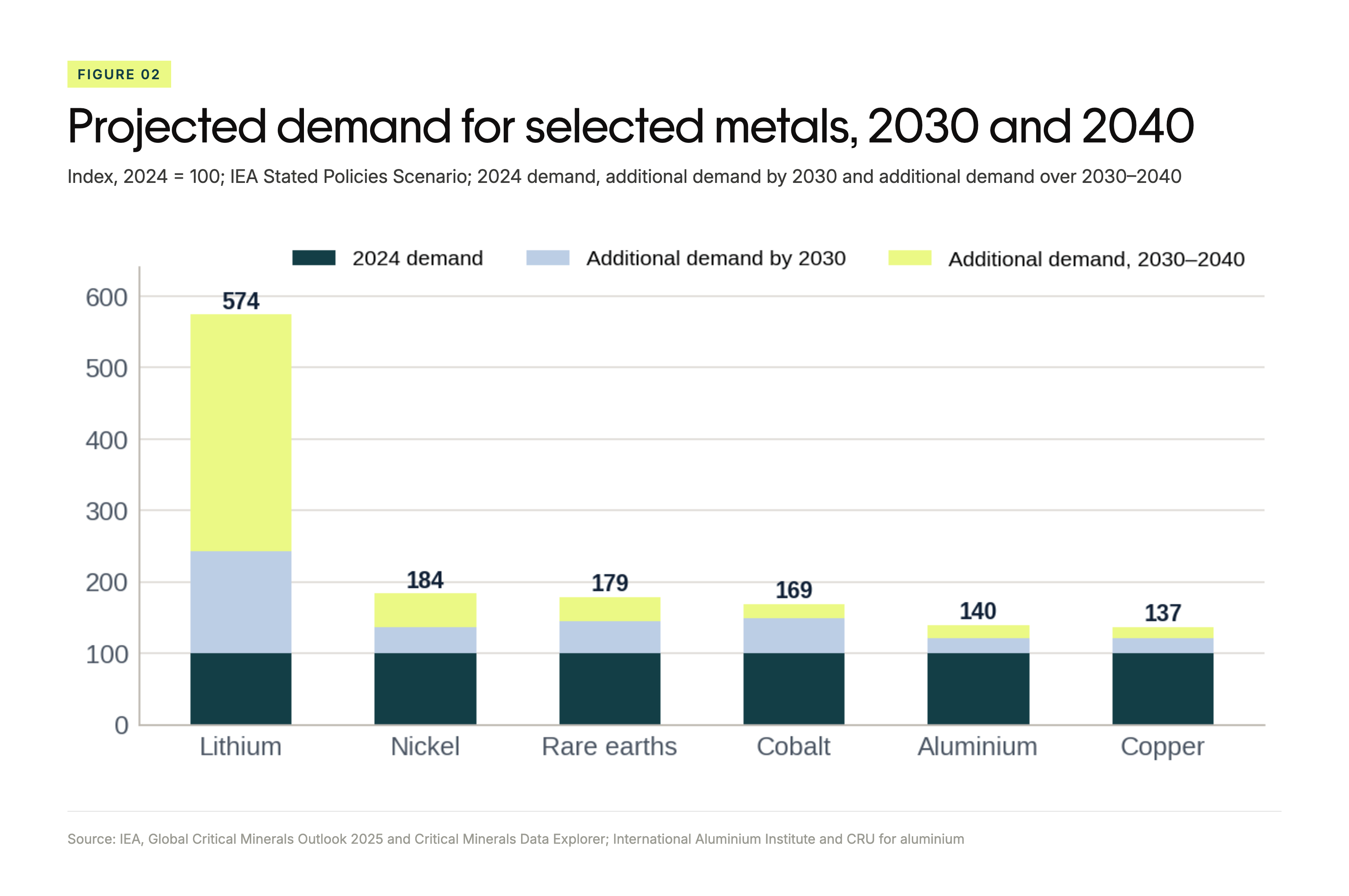
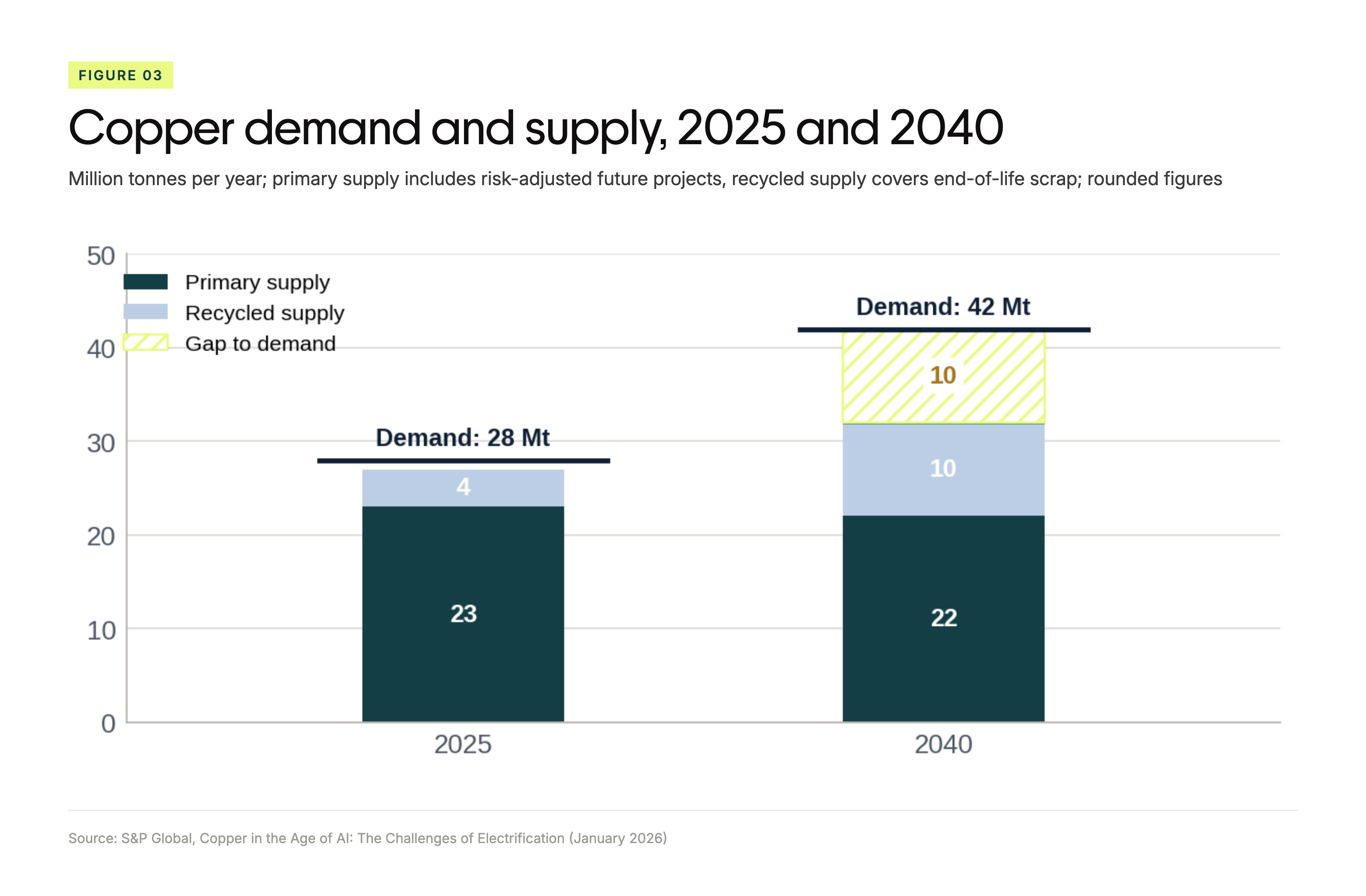
Electrification, digitalization and artificial intelligence now add a further layer of demand, unevenly spread across metals. Under the IEA’s Stated Policies Scenario, global demand for critical minerals is projected to almost double by 2040. Lithium demand is expected to grow the fastest, more than tripling, while nickel demand rises by about 65%. Copper demand is projected to increase by around 7 million tonnes, the largest absolute gain.[2]
Electric vehicles[3] and their batteries, the expansion of power grids, and the deployment and grid connection of renewable energy technologies all drive additional demand for metals, particularly copper and aluminium, on top of existing needs.
Matching this growing demand would require more primary production although expanding mining capacity fast enough remains difficult. Ore grades are falling: in Chile, the world's largest copper producer, the average grade declined from about 1.1% in 2002 to 0.6% in 2024. Miners must therefore move and process more rock for every tonne of metal produced.[4] Lead times are long, averaging around 16 years from deposit discovery to first production, although they vary substantially by mineral and geography.[5] The social and environmental licence to operate is another major constraint. In Panama, the Cobre Panamá copper mine stopped operating in late 2023 after a court ruling and mass protests; in Serbia, Rio Tinto’s Jadar lithium project has been stalled for years by local opposition.
Metal supply chains are highly concentrated. China dominates rare earth refining, the Democratic Republic of Congo supplies about three-quarters of the world's mined cobalt, and Indonesia accounts for most mined nickel. This concentration gives producing and refining countries considerable geopolitical leverage. Since 2023, China has restricted exports of several critical materials and technologies, including rare earths in April and October 2025. The Democratic Republic of Congo suspended cobalt exports in February 2025 before introducing export quotas in October.[6]
Europe is particularly exposed to these concentrated supply chains as it consumes far more metal than it produces. Five metal groups are particularly relevant to its energy and digital transitions: lithium; nickel, cobalt and manganese used in battery cathodes; copper; aluminium; and rare earths used in permanent magnets.[7] Their economic importance, limited substitutability and presence in manufacturing scrap and end-of-life products make them central to Europe's recycling challenge.
Across these five metal groups, the EU accounts for 10-18% of global demand, but only a few percent of primary production at most. Europe has significant copper and cobalt refining capacity, yet remains heavily reliant on imports of lithium, aluminium and rare earths. This dependence is compounded by China's dominance of refining: it leads in 19 of the 20 strategic minerals tracked by the IEA, with an average market share of around 70%. For magnet rare earths, China accounted for about 60% of global mining in 2024 and 85% of refining in 2025.[6]
The EU has expanded its list of critical raw materials from 14 in 2011 to 34 today, based on their economic importance and supply risk. Of these, 17 are classified as strategic. The Critical Raw Materials Act, in force since May 2024, sets non-binding benchmarks for 2030: domestic extraction capacity equivalent to 10% of annual EU consumption of strategic raw materials, 40% for processing and 25% for recycling, with no single third country accounting for more than 65% of supply.[8]
Metal production also comes at a substantial environmental cost, from deforestation and water use to toxic waste. It accounted for 4.6 Gt CO2 eq. emissions, or about 8% of global greenhouse-gas emissions in 2019, reflecting the emissions intensity of smelting and refining.[9] Steel accounts for more than half of the mining and metals sector’s emissions, and aluminium for about 15% - and both already have established recycling industries.
[.green-box]Section 02[.green-box]
Recycling: the most actionable lever among several
Europe can reduce its dependence on imported metals by expanding domestic production, using metals more efficiently and increasing recycling. New mines, extended mine lifetimes and domestic refining can strengthen supply, but require substantial capital and, particularly for new mines, long development times. On the demand side, lighter designs, more efficient manufacturing, longer product lives and substitution can reduce metal requirements, although adoption takes time. Recycling offers a more immediate opportunity by recovering metals already present in manufacturing scrap and end-of-life products.
These approaches are complementary. Stockpiling, trade partnerships and long-term offtake agreements can further strengthen supply security, but do not create additional metal supply. Recycling therefore stands out as one of Europe's most actionable near-term levers.
Recycling does not start from zero. Recycled sources already supply more than a third of the world’s aluminium. End-of-life scrap provides about 17% of copper supply, on top of manufacturing scrap. For cobalt the share is about 10%, for lithium about 3% and for end-of-life nickel about 1%. Less than 1% of rare earth elements are recycled in the EU.[10] Across key energy minerals, the IEA puts the average recycling rate at about 10%. Mature recycling loops thus coexist with others that have barely begun.
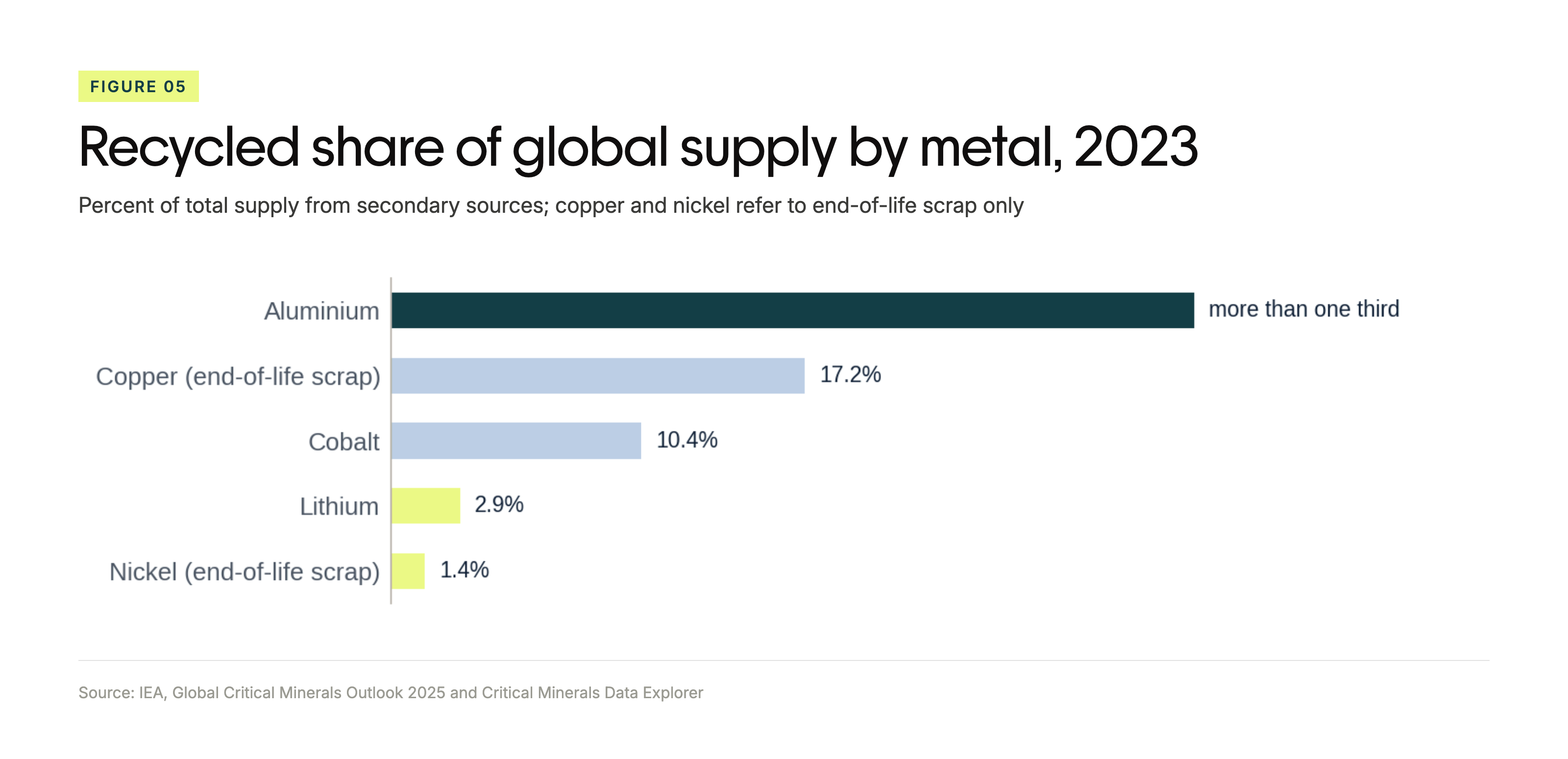
Manufacturing scrap is already abundant, while growing volumes of end-of-life vehicles, electronics, batteries and permanent magnets will become available for recycling as successive generations of products are retired. These feedstocks will emerge at different times and at different scales. The IEA projects global secondary supply to increase across all the metals covered here between 2024 and 2040: lithium from about 7 to 82 kilotons, nickel from 62 to 295 kilotons, cobalt from 26 to 82 kilotons and magnet rare earths from 27 to 43 kilotons. In the much larger aluminium market, secondary supply is projected to rise from approximately 38 to 67 million tonnes.[11]
The environmental case is equally compelling. A 2022 study by KU Leuven, Metals for Clean Energy, estimates that recycling reduces greenhouse-gas emissions by approximately 96% for aluminium, 85% for copper and 29–35% for rare earths compared with primary production. For lithium, nickel and cobalt, the study uses an estimate of around 38%, drawn from the literature rather than individual recycling routes.[12] These differences partly reflect the carbon intensity of primary production, which varies twentyfold across the metals considered. Recycling also reduces the land use, water consumption and pollution associated with mining.
Alongside growing feedstock availability and environmental benefits, European regulation is strengthening the economic case for metals recycling.
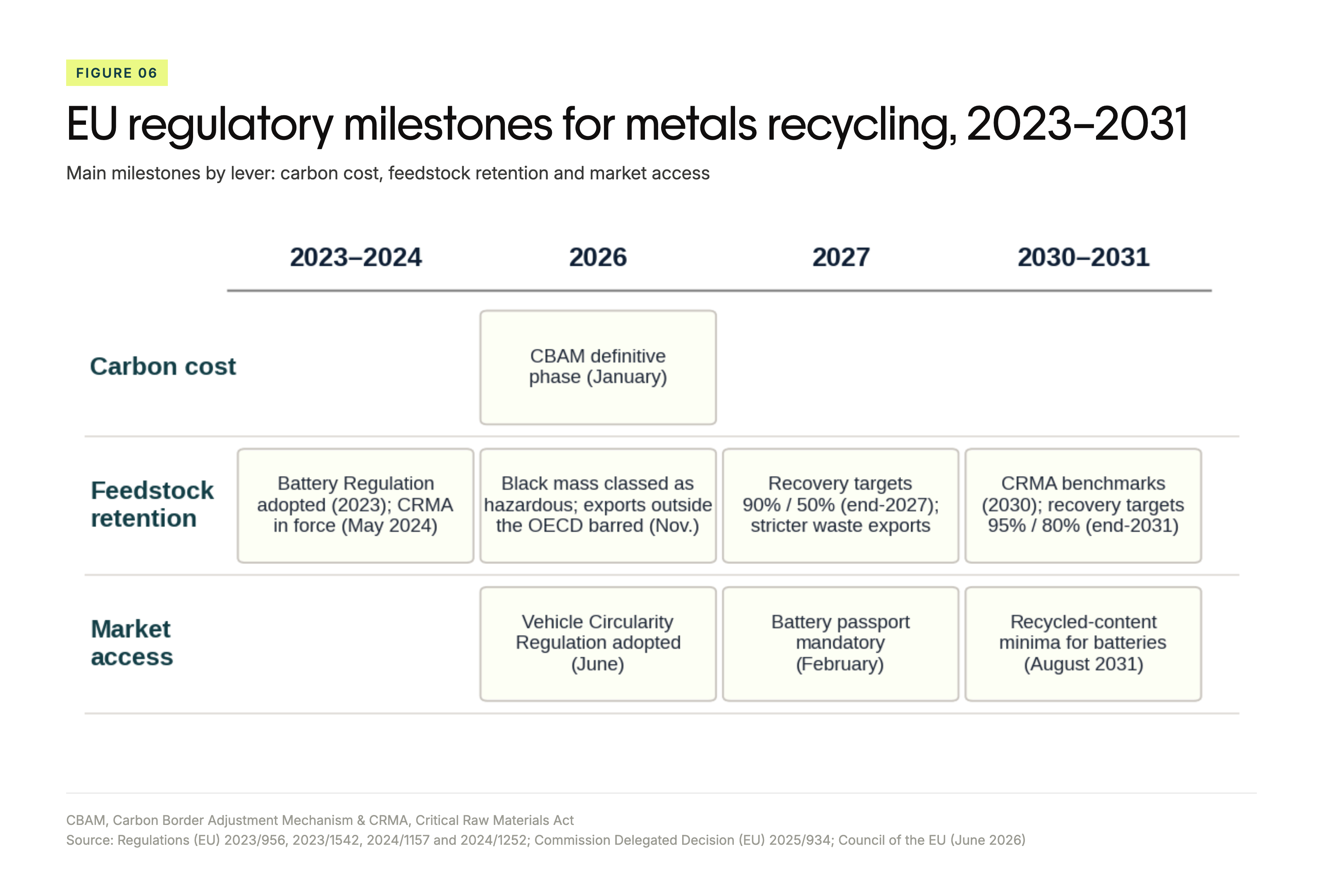
First, carbon pricing is making emissions-intensive primary production more expensive. The Carbon Border Adjustment Mechanism entered its definitive phase in January 2026, while free emission allowances for European steel and aluminium producers are being phased out between 2026 and 2034. This gradually improves the relative economics of lower-carbon recycled metals.
Second, restrictions on waste exports aim to keep more recyclable material within Europe. The revised Waste Shipment Regulation tightens export controls, and from 9 November 2026, black mass from battery recycling is classified as hazardous waste, restricting exports to countries outside the OECD.[13]
Third, the Battery Regulation is creating demand for recycled materials. By the end of 2027, recyclers must recover 90% of cobalt, copper, nickel and lead, and 50% of lithium, rising to 95% and 80% respectively by the end of 2031. From August 2031, new industrial and electric-vehicle batteries must contain minimum recycled shares of 16% for cobalt, 6% for lithium, 6% for nickel and 85% for lead, with higher thresholds from 2036. A digital battery passport will also become mandatory in February 2027.[13] Although recycled-content requirements take effect in 2031, they are already shaping procurement as battery manufacturers qualify suppliers and secure future volumes.
European metal producers, chemical groups, carmakers and recyclers have responded by investing in new recycling capacity. Several facilities are already operational, while others remain under construction or at the planning stage.
Battery recycling illustrates the trade-offs between different processing technologies. Its three main routes (pyrometallurgy, hydrometallurgy and direct recycling) differ in their ability to handle mixed feedstock, recover valuable metals and operate economically at scale.
- Pyrometallurgy smelts batteries at high temperatures. It can process mixed and variable feedstock at commercial scale, but lithium, aluminium and manganese end up in slag, from which recovery is costly.
- Hydrometallurgy uses chemical solutions to separate metals from black mass. It can recover a broader range, including lithium, and is commercially established, but requires substantial quantities of reagents and effluent treatment.
- Direct recycling seeks to regenerate cathode materials without separating them into individual metals. It preserves more of the original material’s value, but requires clean, well-characterized feedstock and remains at pilot stage.
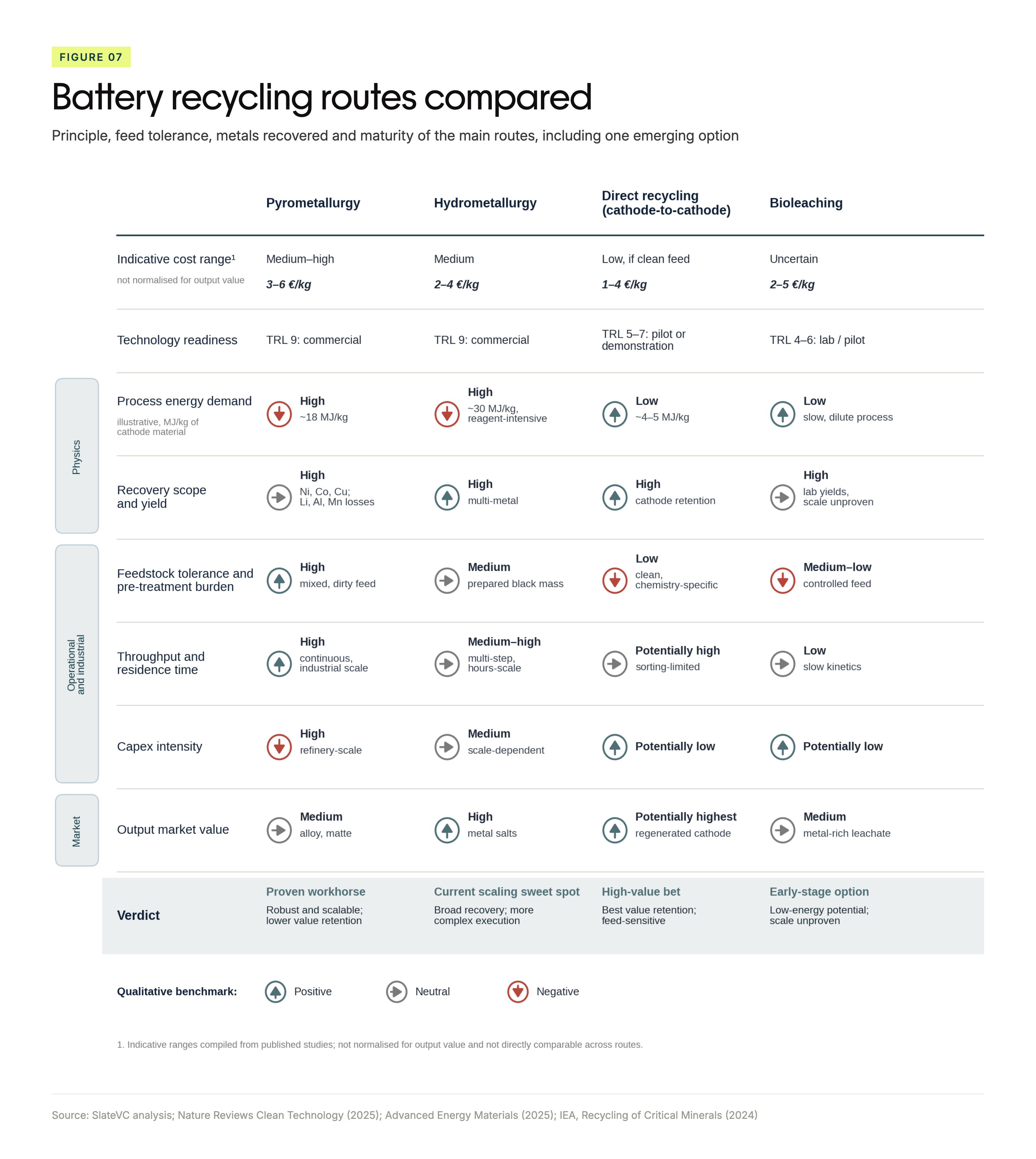
The importance of feedstock quality extends beyond batteries. Copper and aluminium recycling require careful alloy sorting, as impurities introduced during remelting are difficult to remove and can limit the quality of recovered metals. Permanent magnets can be recycled through short-loop processes that preserve the original alloy, or through chemical routes that recover rare earth oxides from more heterogeneous material. Across these metals, the choice of recycling process depends heavily on feedstock composition and quality.
[.green-box]Section 03[.green-box]
Capacity is arriving ahead of the volumes
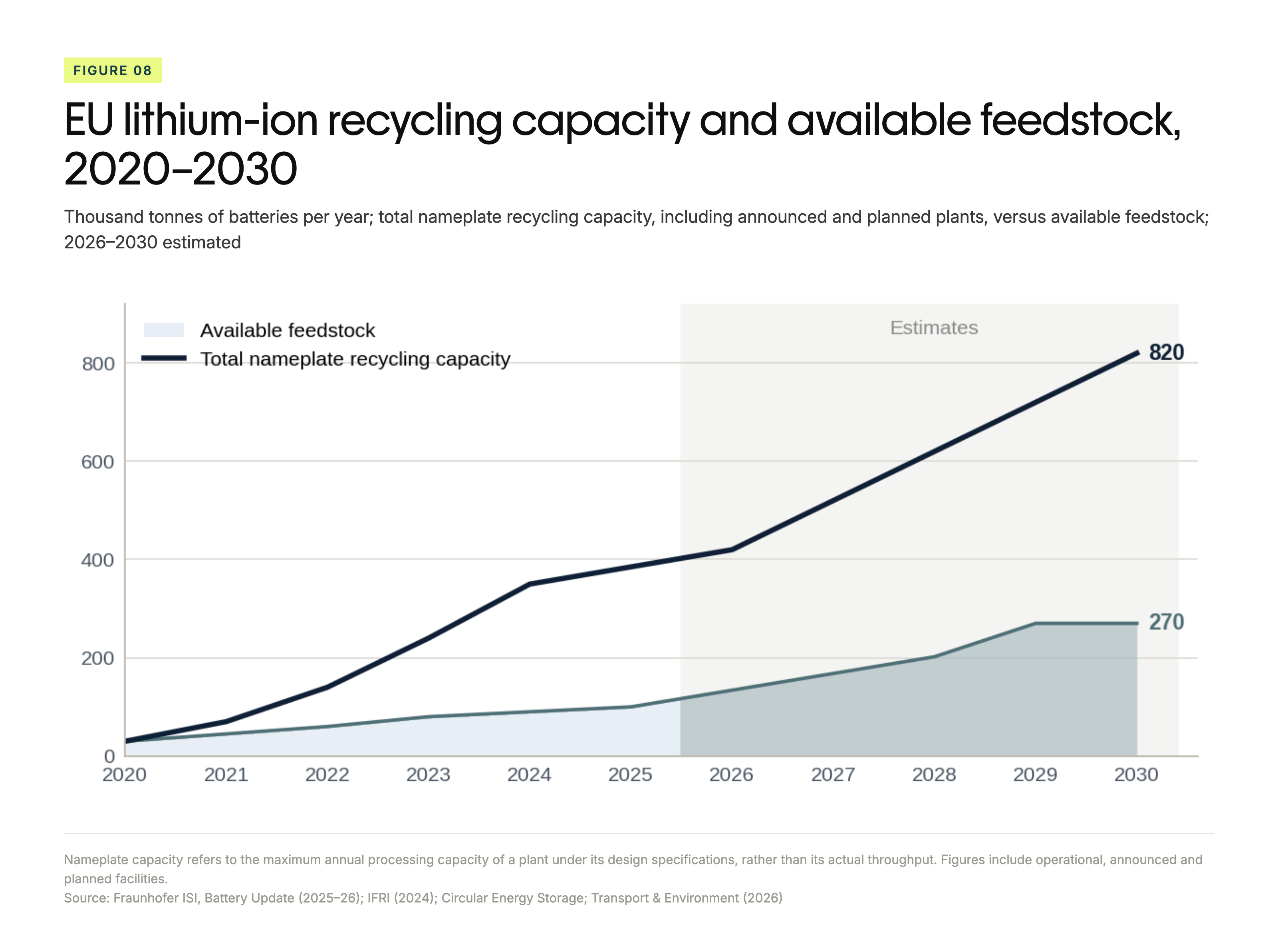
Europe has invested heavily in recycling capacity, but the volumes available to feed these plants have not always kept pace. Battery recycling offers the clearest example. European recyclers anticipated rapid growth in battery production and end-of-life volumes, but both have materialized more slowly than expected. According to Fraunhofer ISI, Europe's lithium-ion recycling capacity, including announced and planned plants, could exceed available feedstock by a factor of three through 2030.[14] Not all this capacity will be built, but the gap between planned capacity and available material is already affecting investment decisions.
For recycling operators, utilization is critical. A plant running below capacity still bears most of its fixed costs, from depreciation and staffing to permits and maintenance. Metal prices add another layer of uncertainty. Recyclers and black-mass buyers value their inputs according to the metals they contain; when prices fall, collecting and processing lower-grade or more dispersed material can become uneconomic.
These pressures have contributed to the postponement of several large recycling projects since 2023. European battery volumes grew more slowly than anticipated, while falling metal prices reduced the value of recoverable materials. After an eightfold increase in 2021-22, lithium prices fell by more than 80% from 2023, undermining margins based on earlier price assumptions. Base-metal prices subsequently recovered by around a third between January 2025 and April 2026, illustrating the volatility operators face. Construction costs also rose. In the United States, Li-Cycle paused its planned 35 kilotons Rochester hub in October 2023 after installation and labour costs pushed its estimated budget from $560 million to $850 million-$1 billion. Meanwhile, China, which accounted for about 80% of global battery pre-treatment and material-recovery capacity in 2023, continues to compete for feedstock through its substantial installed capacity.
European projects have faced similar difficulties. BASF paused its planned refinery in Tarragona, Spain, in July 2024, pending stronger European battery production and electric-vehicle adoption. In October 2024, Eramet suspended its planned hydrometallurgical plant in Dunkirk, France, citing uncertainty over feedstock and customers, while its partner Suez continued its dismantling project. Umicore postponed its planned 150 kilotons plant, originally scheduled for 2026, to 2032 at the earliest, reflecting expectations that end-of-life volumes will arrive later than anticipated. Northvolt sought creditor protection in November 2024 and filed for bankruptcy in Sweden in March 2025.[15]
To mitigate these risks, some industrial players are seeking greater control over their recycling feedstock. ArcelorMittal acquired four scrap recyclers in 2022 to strengthen access to material for lower-carbon steelmaking, while Mercedes-Benz opened an in-house battery recycling plant in Germany in 2024, designed to recover more than 96% of key materials for reuse in battery production.[16]
Securing recycling feedstock is hindered by differences in availability, composition and maturity across waste streams. Manufacturing scrap is generated continuously and is generally well understood. Vehicles and electronic waste already provide substantial end-of-life volumes, while retired electric-vehicle batteries and permanent magnets will become available at scale more gradually. These differences shape both the timing of supply and the challenges involved in recovering valuable metals.
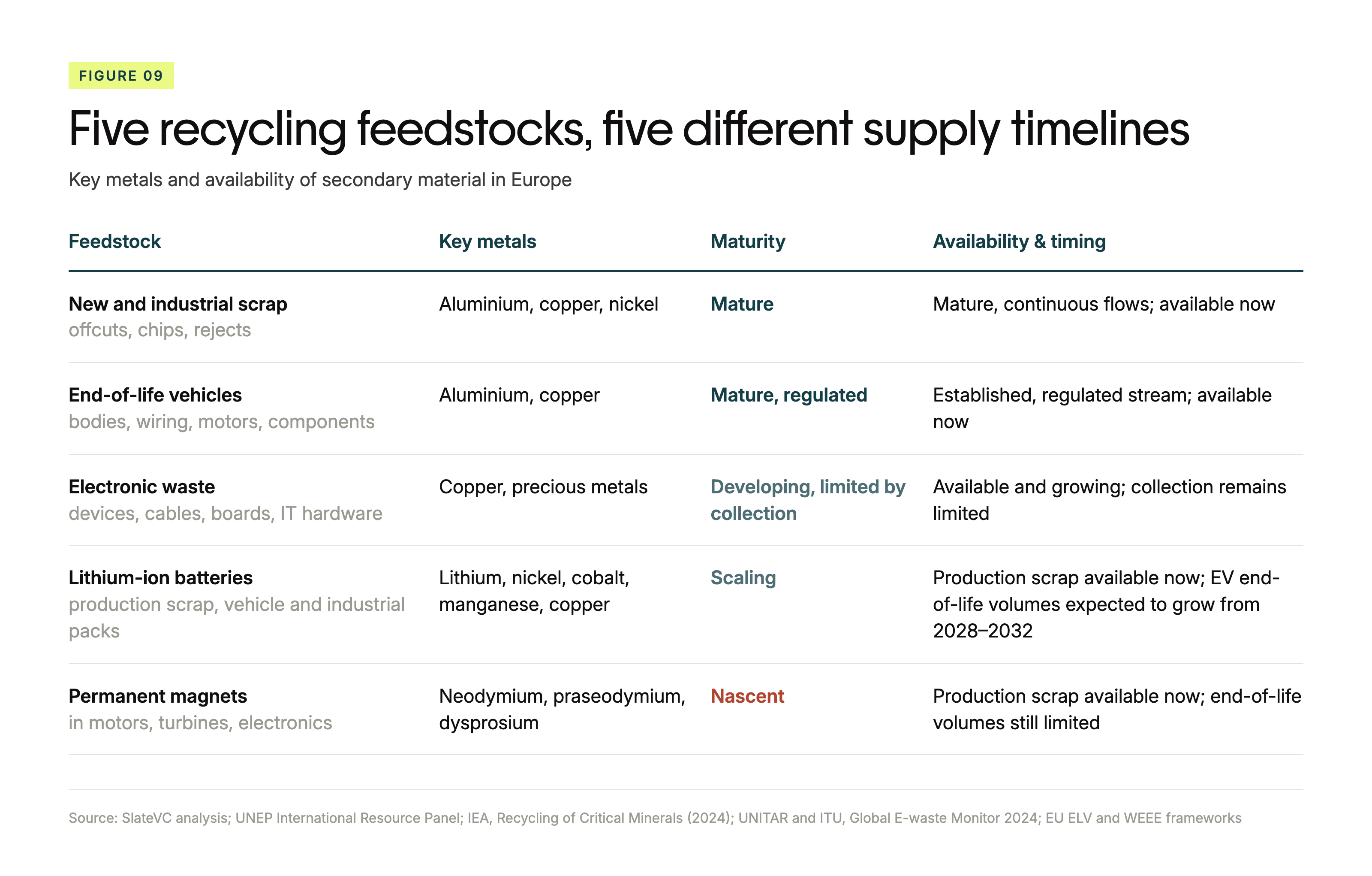
The availability of end-of-life products does not guarantee metal recovery. While industrial scrap is generally clean, segregated and recycled at high rates, post-consumer streams are harder to capture. Around 3.5 million end-of-life vehicles disappear from official EU channels each year, while only 37.5% of electronic waste was collected in the EU in 2023, compared with approximately 22% worldwide.[17]
Once collected, secondary metals pass through a five-stage recycling chain, although not all feedstocks require the same level of processing. Clean manufacturing scrap can often be remelted directly, while complex end-of-life products require dismantling, preparation and separation. Each additional step introduces potential material losses, contamination and costs, ultimately affecting recovery yields and recycling economics.
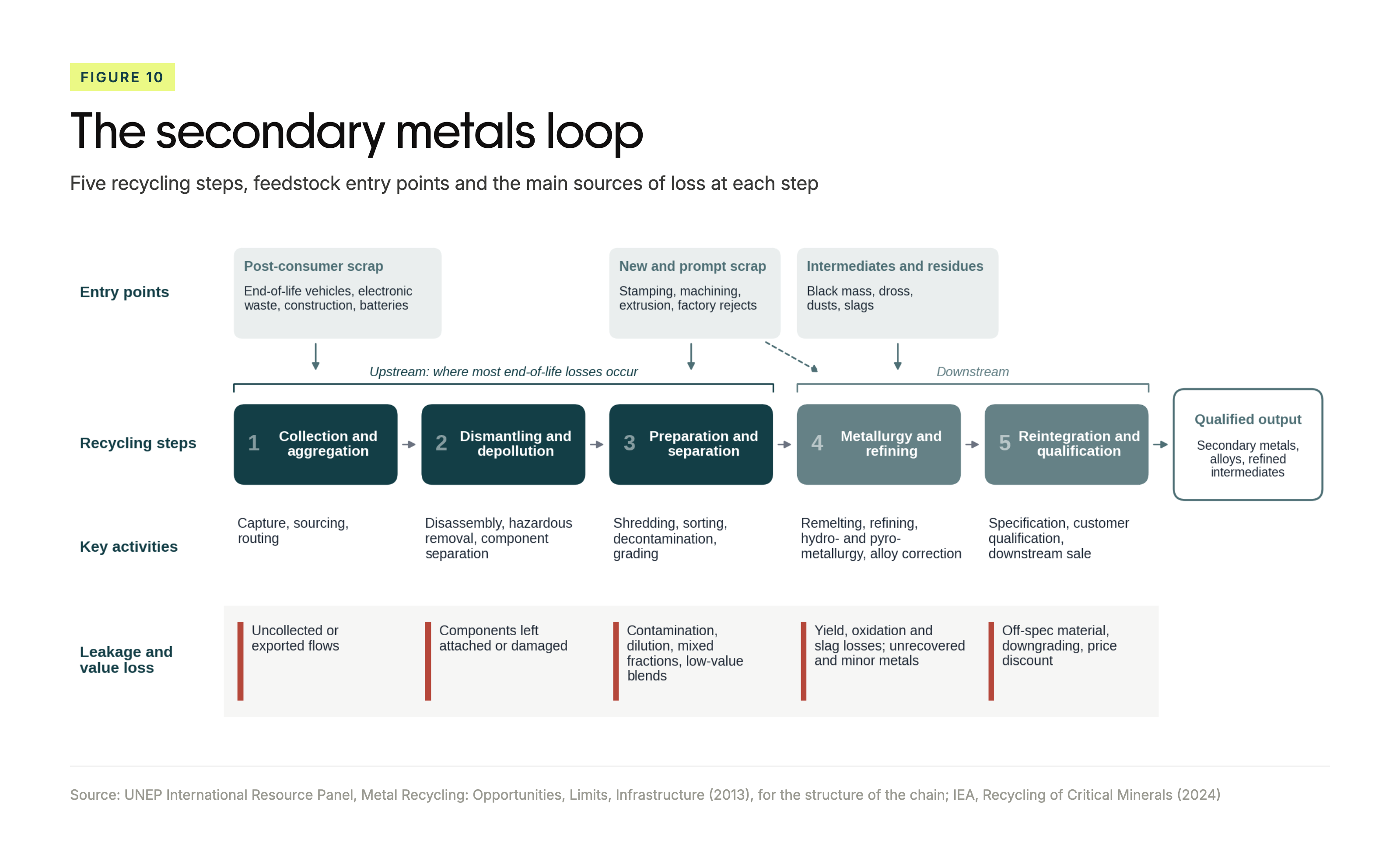
Much of the value lost upstream cannot be economically recovered downstream. Once metals escape collection or are diluted into mixed, low-grade fractions, even advanced refining technologies may be unable to recover them economically. These losses directly affect recycling economics: lower recoverable volumes constrain plant utilization, while poor feedstock quality increases processing costs and reduces the value of recovered materials.
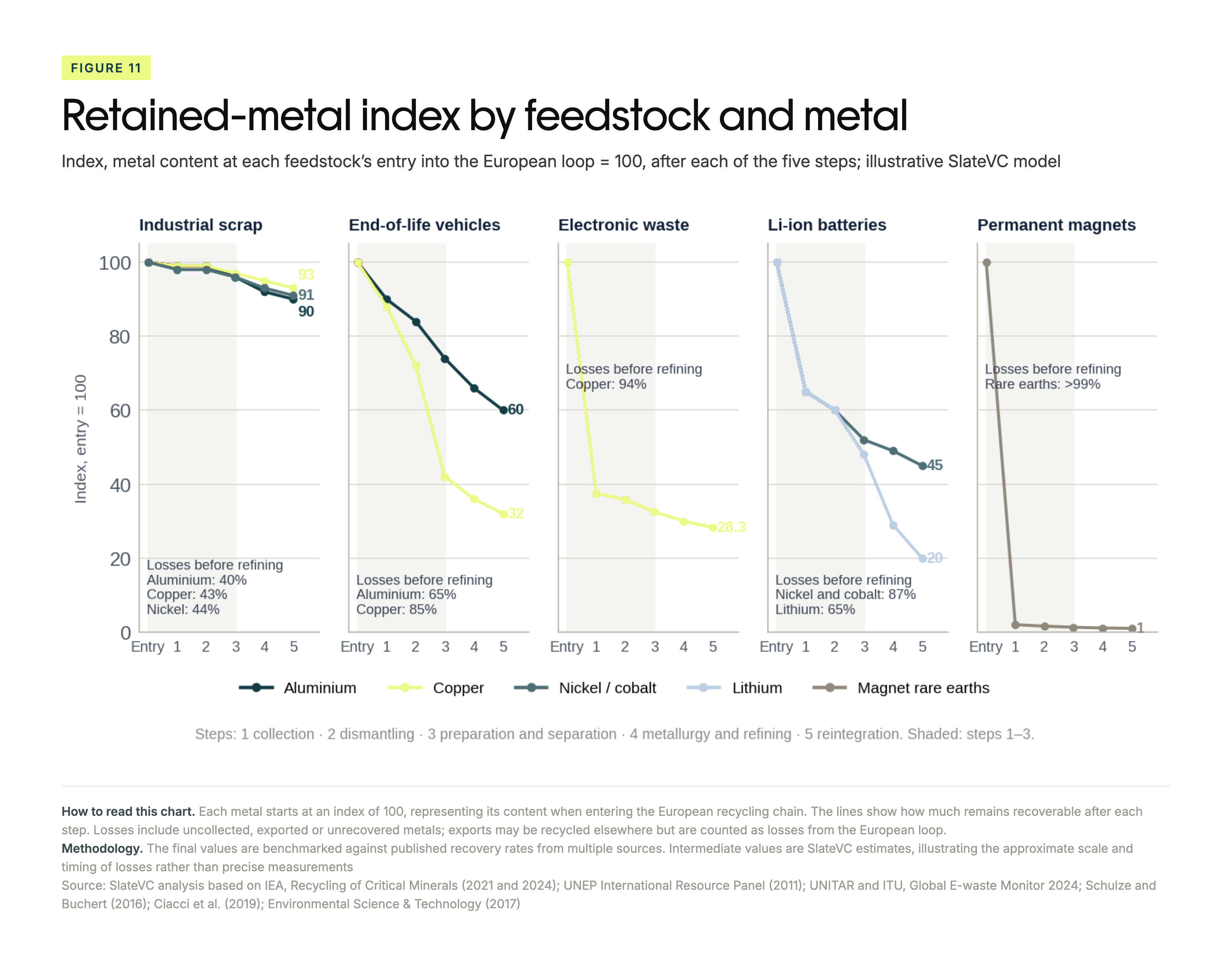
The model suggests that, for end-of-life feedstocks, 65% to over 99% of total recovery losses occur before refining.[18] However, recovery performance depends heavily on both the specific metal and the type of feedstock. Copper illustrates this contrast: industrial scrap retains around 93% of its initial metal content, compared with 32% for end-of-life vehicles and 28% for electronic waste. These differences are rooted in the operational hurdles of collection, dismantling, and separation. Europe can therefore generate substantial volumes of metal-bearing waste while recovering only a fraction as usable secondary material.
Where technology can make the biggest difference depends entirely on the feedstock and its primary bottleneck. We refer to these as technology control points: stages where improvements can have the greatest impact on the quantity, quality or value of recovered metals.
- Industrial scrap: Feedstock access and capture. Already collected and recycled at high rates, clean production scrap offers limited additional recovery potential. Value lies in securing segregated material at source, improving flow orchestration and reducing logistics costs through digital sourcing and traceability.
- End-of-life vehicles: Dismantling and separation. Valuable metals are often diluted into mixed fractions during shredding. Robotic dismantling, selective component extraction and sensor-based sorting can improve recovery rates, material purity and processing efficiency.
- Electronic waste: Collection and aggregation. Fragmented collection channels and heterogeneous products prevent valuable metals from entering formal recycling systems. Digital take-back orchestration, improved material identification and selective dismantling can increase capture rates and recoverable volumes.
- Lithium-ion batteries: Selective recovery and refining. Feedstock availability is still evolving, with production scrap preceding larger end-of-life volumes. Modular recovery processes, automated preparation and selective extraction technologies can improve yields, particularly for lithium, while adapting to changing battery chemistries.
- Permanent magnets: Component identification and extraction. Rare-earth magnets are often embedded in motors and equipment, making recovery difficult once products are shredded. Automated identification, targeted extraction and direct magnet recycling can preserve material value before it is diluted into other scrap streams.
By optimizing capture rates, yields, and material quality while lowering processing costs, technology unlocks new productivity from existing infrastructure. For venture capital, this creates opportunities to improve recycling economics without necessarily owning the plants or the metals they process.
[.green-box]Section 04[.green-box]
Where venture capital creates value
Investment opportunities in metals recycling broadly fall into two categories, each with distinct economics and risk profiles. Owner-operators capture value by sourcing, processing and selling recovered metals, but require significant capital, reliable feedstock and offtake, and strong industrial execution. Technology enablers improve recovery yields, throughput, material quality and operating costs without necessarily owning feedstock or processing assets. They can offer greater capital efficiency and scalability, although industrial performance and customer adoption remain critical.
Both models can present attractive investment opportunities, with different capital requirements and paths to scale. At SlateVC, our primary focus is on technology enablers that deliver measurable value across multiple operators and installations. Five criteria guide our assessment of these businesses:
- A critical industrial pain point. The technology addresses a material constraint in capture, labour productivity, throughput, recovery, quality or compliance, with demand extending across multiple customers and sites
- Measurable customer economics. The solution delivers a demonstrable return through additional recovered value, lower operating costs or greater productivity, supporting attractive pricing and customer payback
- Repeatable industrial deployment. Performance is proven on representative feedstock, and scaling requires progressively less site-specific engineering, commissioning effort and servicing relative to revenue
- Defensible technology and integration. Proprietary processes, differentiated data, accumulated operating experience or integration into customer workflows make the solution difficult to replicate or replace
- Scalable business economics. Revenue and margins can grow without proportional increases in capital, working capital or engineering headcount, supported by repeat equipment sales, recurring services, software or usage-based revenue where appropriate
These investment criteria, combined with our sector mapping and discussions with over 40 companies across the metals recycling value chain, have helped us identify four particularly promising areas for venture capital investment, as of October 2026.
1. Feedstock orchestration. Controlling material flows without owning the material
Technology-enabled platforms connect fragmented sources of scrap with recycling operators, using digital sourcing, material intelligence and logistics coordination to improve feedstock availability and plant utilization. Opportunities range from software and service-based solutions to digital marketplaces and technology-enabled trading platforms.
2. Automated dismantling and intelligent separation. Preserving material value through automation
Robotics, computer vision and sensor-based sorting can improve material recovery, purity and labour productivity while reducing processing costs. Opportunities span intelligent sorting equipment, robotic dismantling systems and automation software, with applications across electronic waste, end-of-life vehicles and batteries.
3. Selective recovery and short loops. Unlocking higher-value recovery from complex streams
Advanced hydrometallurgical, electrochemical and other selective recovery technologies can improve metal recovery yields and purity, particularly from complex or high-value secondary streams. Opportunities span proprietary processes, modular equipment and direct recycling solutions, offering more flexible alternatives to conventional metallurgical routes.
4. Cross-cutting software and enabling layers. Building recurring workflows around material intelligence
Digital solutions, from material intelligence and traceability to industrial analytics and process optimization, can improve material quality, operational efficiency and decision-making across the recycling chain. Beyond regulatory compliance, the opportunity lies in platforms that unlock tangible industrial gains and become mission-critical to daily operations.
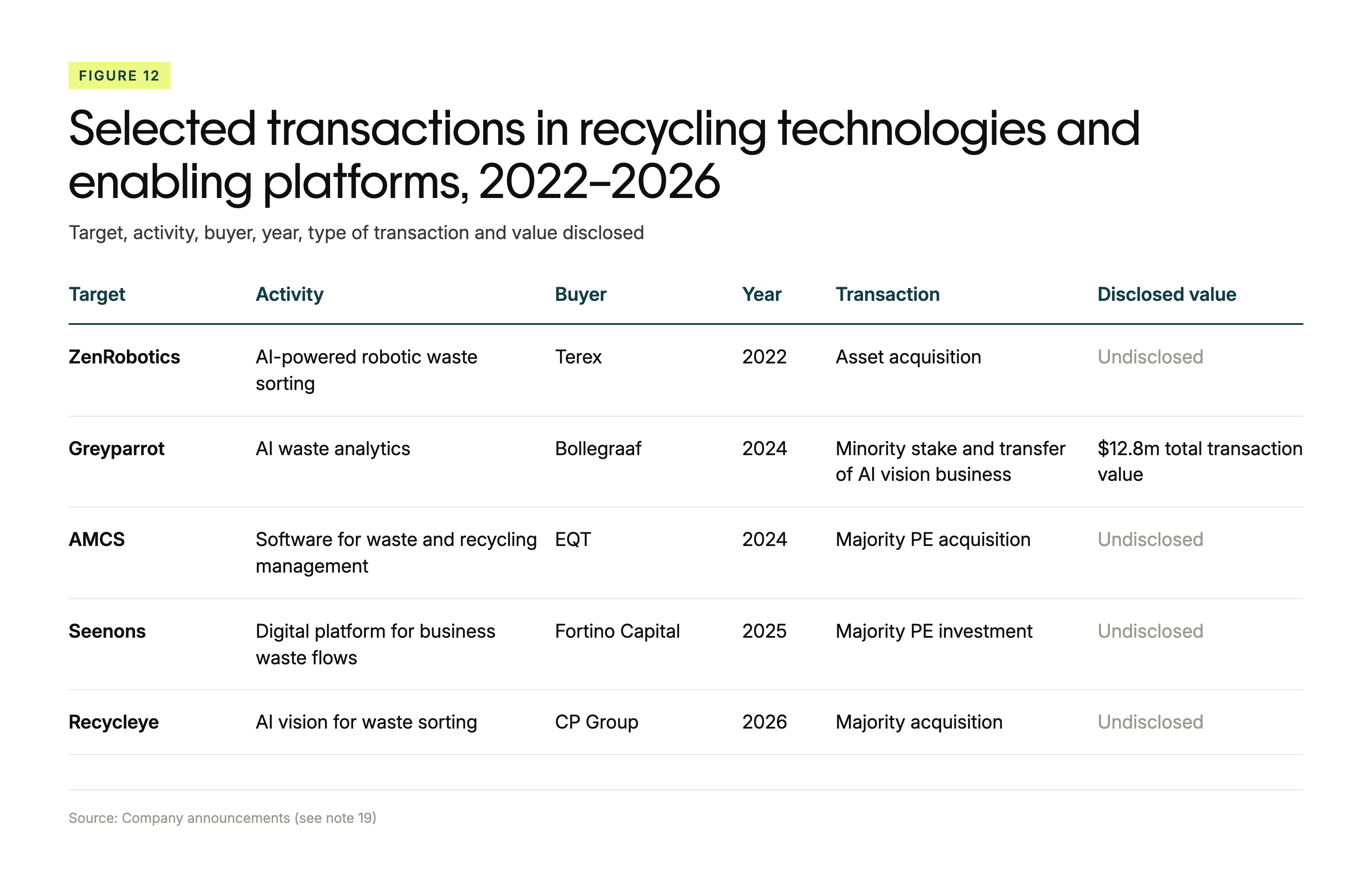
Recent transactions illustrate strategic interest in recycling automation, material intelligence and digital coordination. Equipment manufacturers are incorporating AI and software into their portfolios through acquisitions and partnerships, while financial investors are backing platforms built around fragmented waste flows. These transactions are not directly comparable in structure or valuation, but illustrate potential routes to strategic integration, industrial partnerships and future exits.
Conclusion
Europe's metals challenge comes down to three priorities: securing supply, improving industrial competitiveness and reducing environmental impact. Recycling can contribute to all three, supported by growing regulatory incentives. But delivering on this potential requires more than expanding processing capacity: it means improving the efficiency of the entire recycling chain, from collection to qualified output.
For SlateVC, this creates an investment opportunity across the recycling value chain. From feedstock orchestration and intelligent separation to selective recovery and industrial software, technology can improve the productivity of existing infrastructure and unlock new sources of secondary metal supply. The next gains in European metals recycling will come not only from building more plants, but from making every tonne of material count.
Authors
Chloé Giard, General Partner
Paul Pihouée, Associate
Notes
- United Nations, World Population Prospects 2024; Maddison Project Database (2023).
- IEA, Global Critical Minerals Outlook 2026 (July 2026), Stated Policies Scenario.
- IEA, The Role of Critical Minerals in Clean Energy Transitions (2021).
- Chilean Copper Commission (Cochilco) weighted average ore grade of Chilean copper mines. Anuario de Estadísticas del Cobre y Otros Minerales 2005–2024 (2025), Table 50, p. 92
- IEA (2021): about 16.5 years on average for mines that started production between 2010 and 2019.
- IEA, Global Critical Minerals Outlook 2025 and 2026; IEA, With new export controls on critical minerals, supply concentration risks become reality (2025); ARECOMS, Decision No. 001/ARECOMS/2025 (22 February 2025) and subsequent communications.
- Scope: metal groups selected from the EU lists of strategic and critical raw materials for their recyclability at scale, concentration in durable goods and limited substitutability. Ferrous metals and platinum-group metals are excluded.
- European Commission, criticality assessments (2011–2023); Regulation (EU) 2024/1252 (Critical Raw Materials Act), Article 5.
- IPCC, Sixth Assessment Report, Working Group III (2022), 2019 global greenhouse-gas emissions reference and industrial emissions estimates, used for the 4.6 Gt CO2-eq and approximately 8% global share quoted in the text; ICMM and Wood Mackenzie, Global Mining and Metals Greenhouse Gas Emissions Dataset (published March 2026; 2024 data), for the sectoral breakdown across mining, metals production and processing. The estimates differ in year and scope and should not be treated as a single dataset.
- Recycled input rates in global supply, 2023. IEA, Global Critical Minerals Outlook 2025 and Critical Minerals Data Explorer.
- IEA, Global Critical Minerals Outlook 2025, Stated Policies Scenario; International Aluminium Institute.
- KU Leuven for Eurometaux (now European Metals), Metals for Clean Energy (2022).
- Regulation (EU) 2023/956 (CBAM); Directive (EU) 2023/959 (EU ETS, phase-out of free allocation for CBAM sectors); Commission Delegated Decision (EU) 2025/934, applicable from 9 November 2026; Regulation (EU) 2023/1542 on batteries, Articles 8 and 77 and Annex XII.
- Fraunhofer ISI, Battery Update (2025–26). Total nameplate recycling capacity, including announced and planned plants, against available feedstock; values after 2025 are estimates.
- IEA, Global Critical Minerals Outlook 2025 (lithium prices), Global Critical Minerals Outlook 2026 (base-metal prices) and Recycling of Critical Minerals (2024) (Chinese capacity); Li-Cycle, third-quarter 2023 results (13 November 2023) and CCAA filing (14 May 2025); BASF and Umicore (July 2024); Eramet, third-quarter 2024 report (24 October 2024); Northvolt (November 2024 and March 2025).
- ArcelorMittal, annual report 2022; Mercedes-Benz (October 2024).
- Council of the EU, Vehicle Circularity Regulation (2025–2026); Eurostat, WEEE statistics (2023 data); UNITAR and ITU, Global E-waste Monitor 2024; IEA, Recycling of Critical Minerals (2024); Rizos et al. (2022).
- Illustrative SlateVC model, calibrated on IEA (2021 and 2024), UNEP IRP (2011), Global E-waste Monitor 2024, Schulze and Buchert (2016) and Ciacci et al. (2019). See the note under the chart. The electronic-waste row is calibrated on the EU collection rate (Eurostat, 37.5% in 2023), with later steps keeping the model’s step-by-step yields.
- Terex Materials Processing, 'Terex MP Acquires ZenRobotics' (11 August 2022); Bollegraaf and Greyparrot, strategic AI partnership announcement (7 February 2024); EQT / AMCS, majority investment announcement (14 August 2024); Fortino Capital / Seenons, majority investment announcement (1 July 2025); CP Group / Recycleye, majority acquisition announcement (14 April 2026). Transaction structures and disclosed values are as described in the respective company announcements.
Principal sources
The analysis in this article draws principally on the following sources: International Energy Agency, Global Critical Minerals Outlook 2025 and 2026, Critical Minerals Data Explorer (May 2026 update), Recycling of Critical Minerals (2024) and The Role of Critical Minerals in Clean Energy Transitions (2021); S&P Global, Copper in the Age of AI (2026); BloombergNEF, Transition Metals Outlook 2025; USGS, Mineral Commodity Summaries 2025; BGS, World Mineral Statistics 2025; International Aluminium Institute; Chilean Copper Commission (Cochilco); European Commission Joint Research Centre, Raw Materials Information System; KU Leuven, Metals for Clean Energy (2022); UNEP International Resource Panel (2011 and 2013), for the structure of the recycling chain; UNITAR and ITU, Global E-waste Monitor 2024; Fraunhofer ISI, Battery Update (2025–26); ICMM and Wood Mackenzie (2026); EU legislative texts on critical raw materials, batteries, vehicles, waste shipments, emissions trading and carbon border adjustment; company announcements and filings; and SlateVC proprietary analysis, informed by more than 40 interviews with companies and industry experts across the value chain.
Disclaimer. This article reflects SlateVC’s internal perspective as of October 2026, grounded in desk research, ecosystem mapping and direct engagement with companies across the metals recycling value chain. It does not constitute investment advice. The data and classifications presented are illustrative and reflect a point-in-time view. They do not constitute a final investment strategy or a commitment to specific sub-segments. References to companies and transactions rely on public information and do not imply any relationship with SlateVC or any assessment of these companies. Past performance is not indicative of future results.
SlateVC — 5 Avenue de l'Opéra, 75001 Paris, France · slate.vc