.svg)
.svg)
The electric shift in industrial heat

[.green-heading]Key Takeaways[.green-heading]
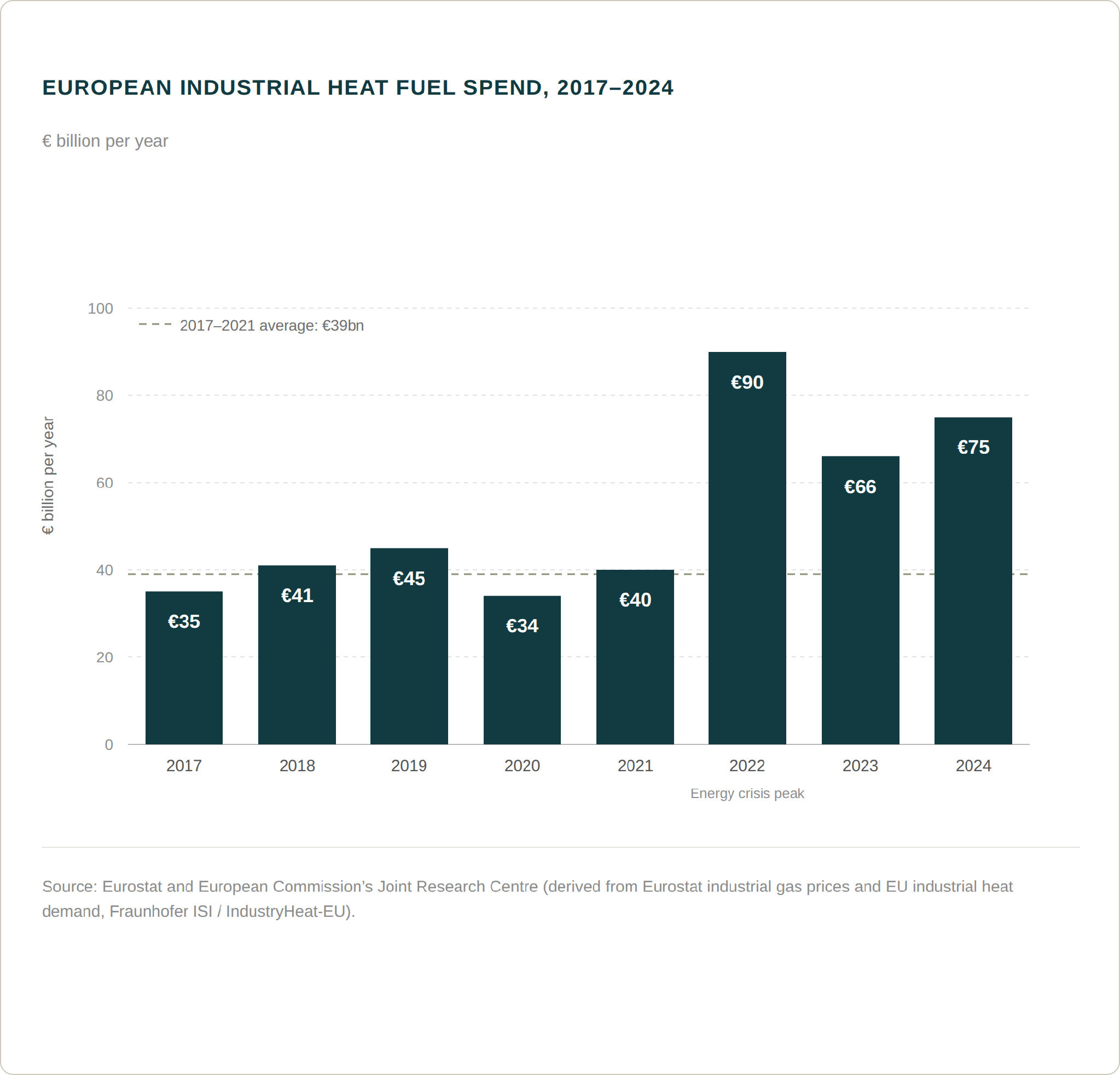
- Industrial heat is a structurally large and heavily emitting market: it accounts for roughly 1,600 TWh a year of final energy demand in the European Union, or 16% of the total. Today, 75% of industrial process heat is still produced by burning fossil fuels. Europe spends more than €75 billion a year on fuel for industrial heat.
- Three forces are putting its electrification at the forefront of the industrial agenda, where cost and resilience meet decarbonisation. Industrials remain heavily exposed to gas imports and volatile prices, a vulnerability that recent years have made impossible to ignore. At the same time, the electricity grid grows cleaner with each wave of renewable build-out, steadily lowering the carbon intensity of everything that runs on power. Lastly, a fast-moving package of EU regulation and funding is redrawing the economics beneath all of this, shifting the burden away from electricity and onto the fossil fuels it competes with.
- Storage is a critical piece of the puzzle to benefit from intraday volatility in electricity prices linked to renewable penetration. It enables industrials to draw power when it is cheap or negative-priced and discharge heat when demand, and prices, peak, converting electricity price volatility into a source of margin.
- Several technologies exist to generate and store electrified heat. The innovation stems from the combination of technologies and the business model offered to industrial companies. Resistance-based heating and simple storage for medium heat temperatures enable cost-competitive and reliable heat. More innovative technologies, such as induction, target high temperature heat which seems difficult to provide for resistance heating.
- We believe the most durable opportunities combine de-risked technology with an agile business model that removes the upfront capital burden for cash-constrained, risk-averse industrial customers. Independently of technologies, flexible and customer-centric business models stand out: offering Heat-as-a-Service and EPC, optionality to include trading, and hybridisation of existing gas boilers to limit disruption to the core industrial process.
[.green-box]Section 01[.green-box]
A large market still running on fossil fuels
Industrial process heat is one of the largest and least visible pieces of Europe’s energy system. It accounts for approximately 1,600 TWh of demand every year, or roughly 16% of European final energy consumption[1]. It represents 64% of all energy used by industry itself, ahead of mechanical processes and lighting at 28% and space heating at 8%. It is, in effect, the primary driver of both manufacturing cost and manufacturing emissions across the continent.
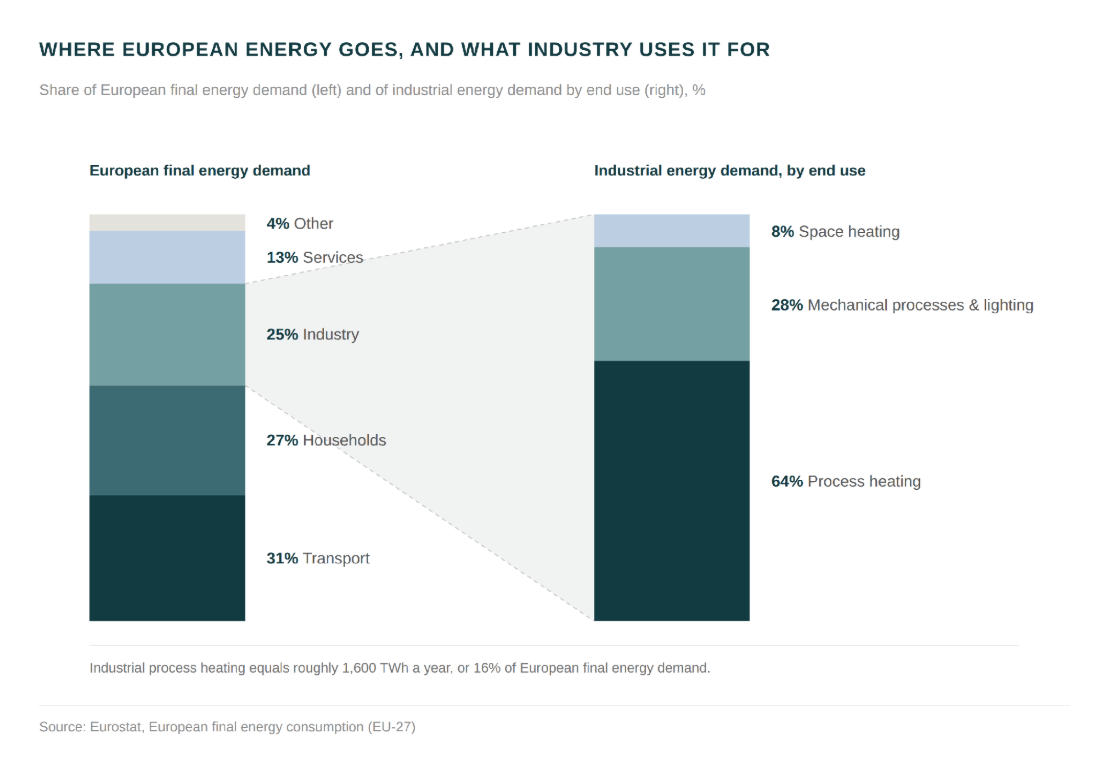
Three-quarters of that heat is still produced by burning fossil fuels[2]. Process heat has historically run on the same gas boilers and furnaces for decades, with little pressure to change so long as gas remained cheap and reliable.
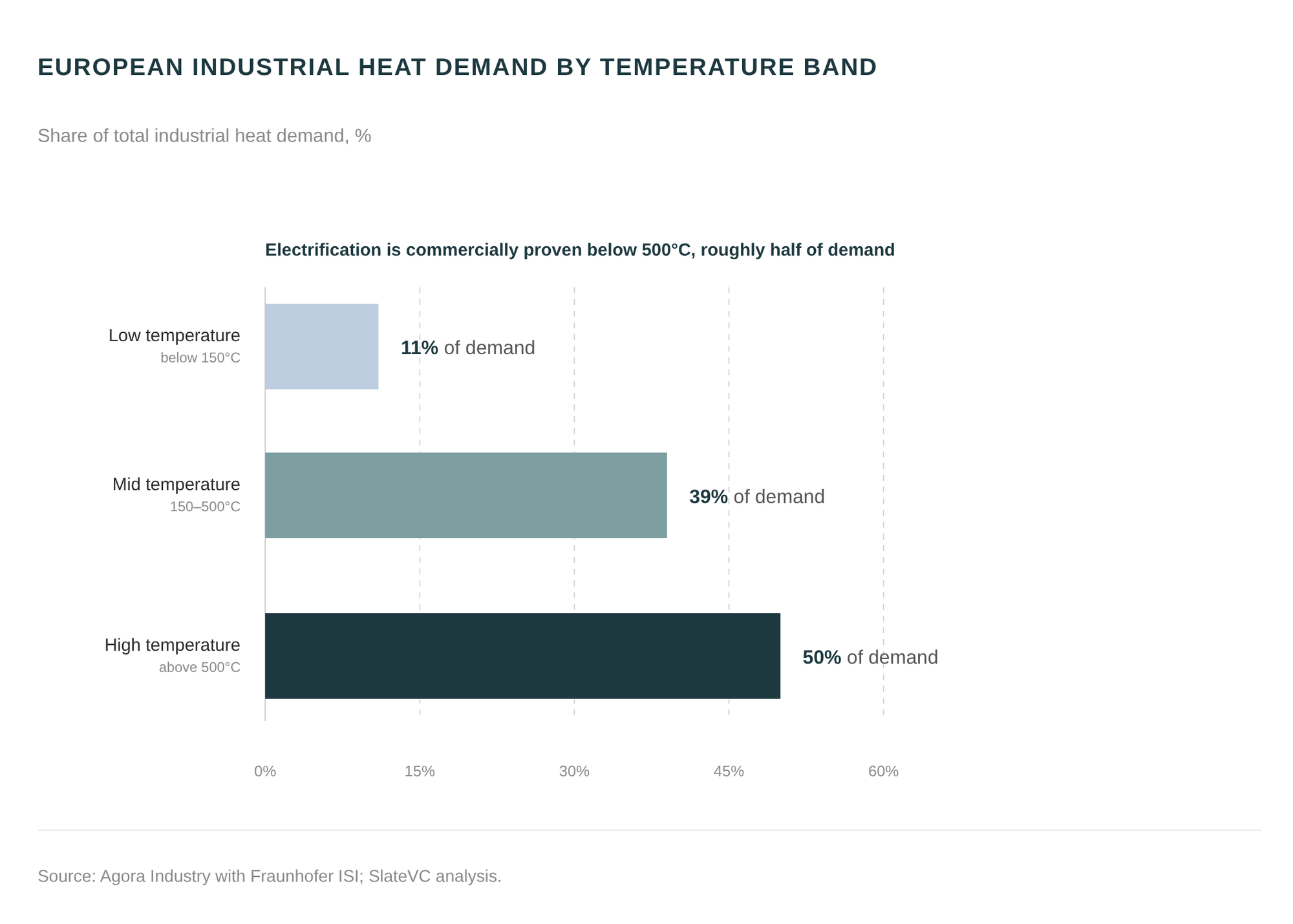
That assumption no longer holds, and the temperature profile of demand shows where the opportunity is already open. Roughly half of European industrial heat demand sits below 500°C[3], concentrated in food processing, pulp and paper, and chemicals, where electrification technologies such as resistance-based heating and industrial heat pumps are already mature. The other half, dominated by steel, cement, glass and metal processing, requires higher temperatures, up to 2,000°C, which natural gas reaches easily but for which electric alternatives are fewer and more recent.
Direct electric heating converts electricity into usable heat at an efficiency of 90% or more. Hydrogen-based alternatives, by comparison, deliver closer to 40% efficiency once production and conversion losses are accounted for, meaning direct electrification is more than twice as efficient a pathway wherever it is technically viable. That efficiency gap, combined with the sheer size of the addressable market, is what makes electrification of industrial heat one of the more consequential and underexplored fronts of the energy transition.
The value at stake is substantial. Europe spent an estimated €75 billion on industrial heat fuel in 2024[4]. Globally, industry spends about €30 billion a year on heat equipment[5]. Thermal energy storage capacity, close to negligible today at less than 0.5 GWh, could exceed 200 GWh by 2035, representing a cumulative capital expenditure opportunity of roughly €16 billion over the coming decade[6].
[.green-box]Section 02[.green-box]
Three forces are pulling industrials toward electrification
The case for electrifying industrial heat no longer rests on decarbonisation alone. It is increasingly an economic argument, and it rests on three reinforcing dynamics: exposure to higher and more volatile gas prices, the accelerating decarbonisation of the electricity grid, and a regulatory and funding push that is explicitly designed to close the remaining cost gap.
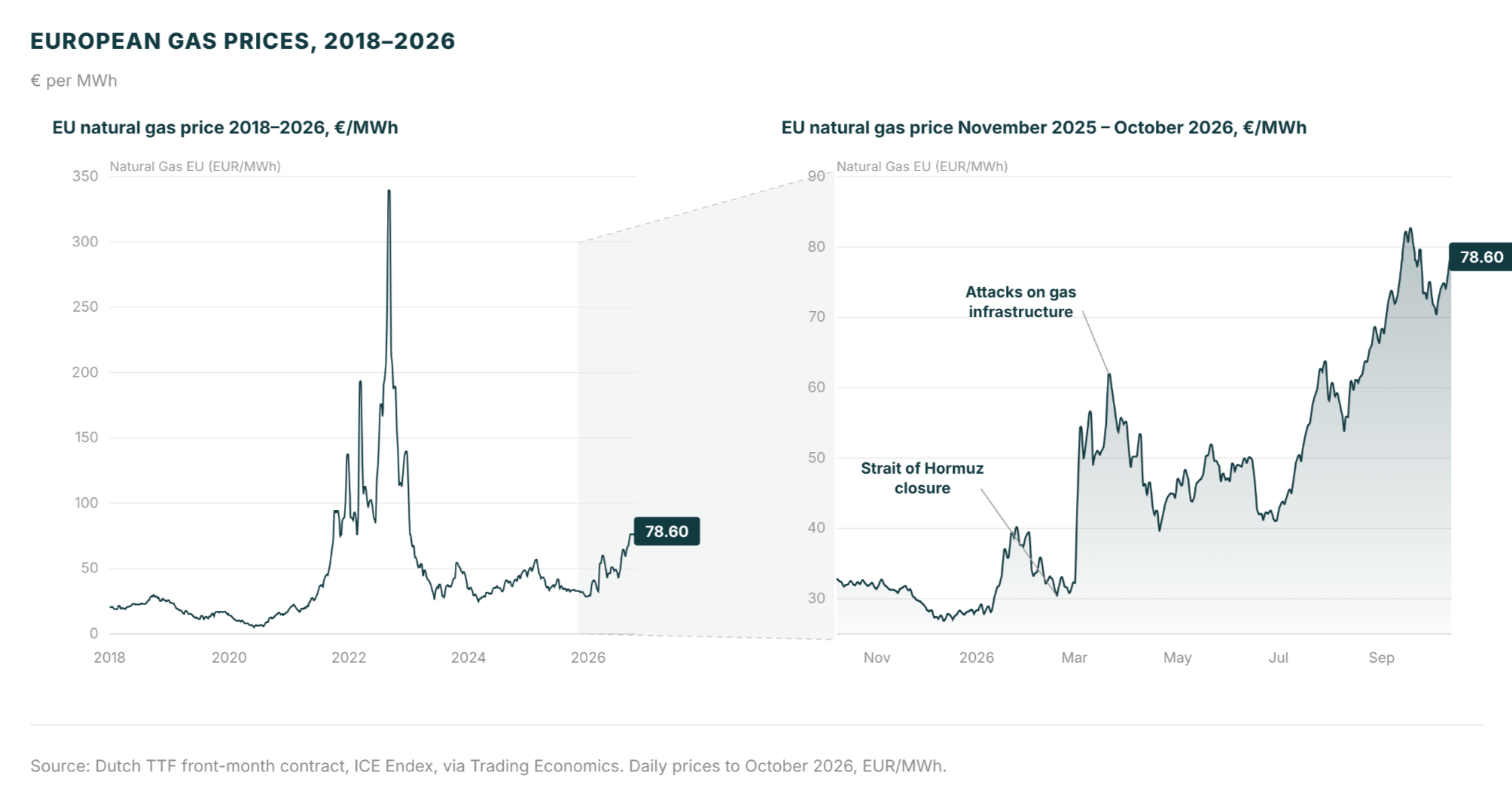
Europe imports more than 80% of its natural gas, a dependency that has translated directly into cost exposure. The EU’s fossil fuel import bill peaked at €604 billion in 2022 and remained at €427 billion in 2024, a persistent drain on the European economy[7]. European industrial gas prices remain two to four times higher than in its main trading partners, eroding the competitiveness of energy-intensive sectors including chemicals, steel, cement and food processing[7]. The IEA estimates that switching European industry to electrified heat could reduce gas imports by approximately 35 billion cubic metres a year[8]. European gas fell from its 2022 peak near €340/MWh to below €30 at the end of 2025, before the Strait of Hormuz closure and attacks on gas infrastructure in March 2026 pushed it above €60. It trades near €79 in October 2026[9].
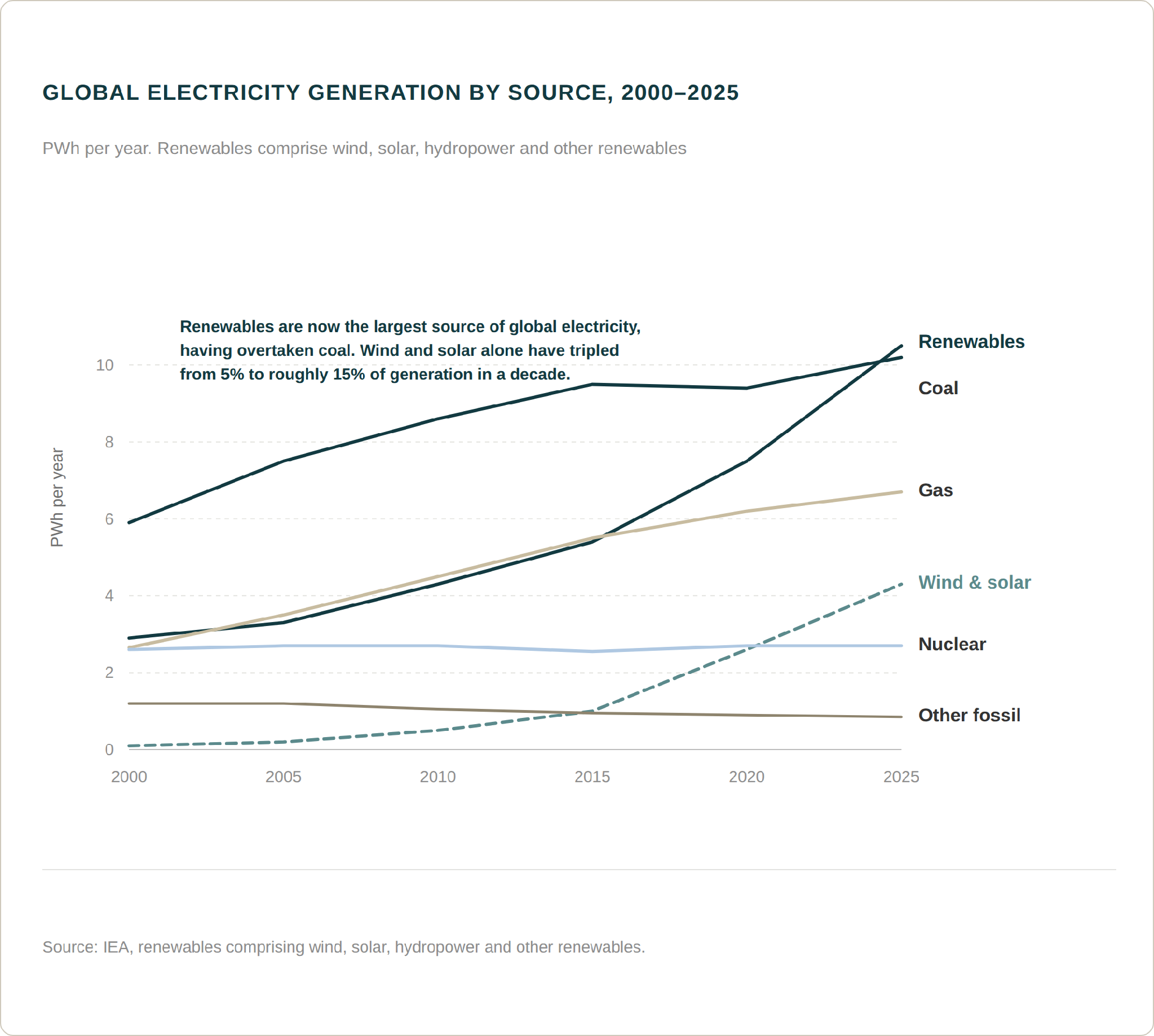
At the same time, the electricity that would power that shift is getting cleaner and, increasingly, cheaper at the margin. A decade ago, wind and solar supplied less than 5% of the world's electricity. That share has more than tripled to 17% in 2025, and renewables as a whole overtook coal for the first time[10]. European electricity has, as a result, fallen below the carbon intensity of natural gas, at approximately 170 grams of CO₂ per kWh against 200 grams for gas[11].
Rising renewable penetration has a second, less obvious effect: it widens the swings in intraday electricity prices, including a growing number of hours priced at zero or below. In April 2019, only 6% of hours saw electricity cheaper than gas. By April 2025, that figure had reached 56%[12]. Those low and negative-price windows create a direct opportunity to produce decarbonised industrial heat at near-zero marginal cost, provided the heat can be generated, or stored, when electricity is cheapest. For an industrial site equipped with storage, that volatility is a source of margin: charge when supply is abundant and prices are low, discharge when demand and prices peak. Europe’s flexibility market is expected to grow from €4 billion in 2024 to €12 billion by 2030 on the back of this dynamic, with wholesale arbitrage alone approaching €9 billion by 2030[13].
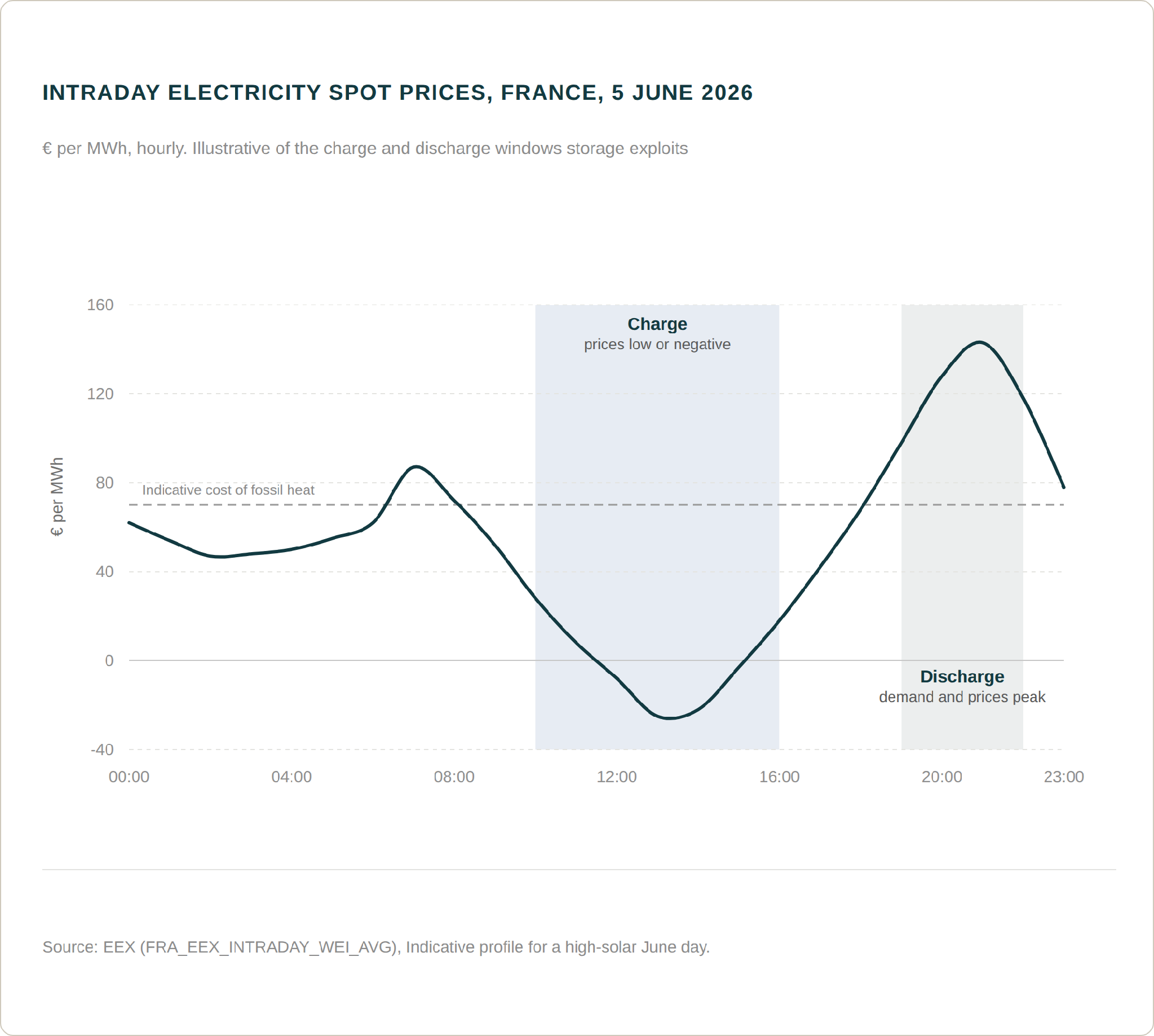
The same electricity price volatility that creates complexity on the grid becomes, for an industrial site equipped with thermal storage, a direct source of margin.
Regulation is moving quickly to support the transition. The European Commission’s Industrial Accelerator Act, proposed on 4 March 2026, fast-tracks permitting through a Single Digital Permit. Heat assets are reclassified as flexibility assets, allowing a factory to operate as a virtual battery and earn demand-side response revenue[14].
The Electrification Action Plan, published on 17 July 2026, sets an indicative target of 46% electrification of final energy consumption by 2040, roughly double the current 23% share, which has not moved in a decade. It seeks to narrow the cost gap between electricity and fossil fuels through measures to reduce electricity costs and reform network charges and taxation. It also streamlines grid access, addressing key barriers to scaling electrification technologies such as Heat-as-a-Service. The plan cites an industry benchmark of €50/MWh for total electricity costs as a useful reference point for the price level at which industrial electrification becomes more economically attractive. The Commission estimates that reaching the 2040 electrification target could reduce the EU’s fossil fuel import bill by €260 billion a year once the target is met[14].
The Innovation Fund Heat Auction, launched in June 2026 with a budget of up to €1 billion, adds first-loss guarantees and five-year revenue premiums for the most cost-effective projects replacing fossil heat with electrified or renewable alternatives[14]. Underpinning all of it, the EU’s climate law binds the bloc to a 90% reduction in net greenhouse gas emissions by 2040 against 1990 levels, with carbon costs rising under both ETS I and ETS II[14].
Taken together, these instruments are supporting the shift towards electricity at exactly the moment gas prices remain structurally elevated.
[.green-box]Section 03[.green-box]
Generation and storage technologies work together
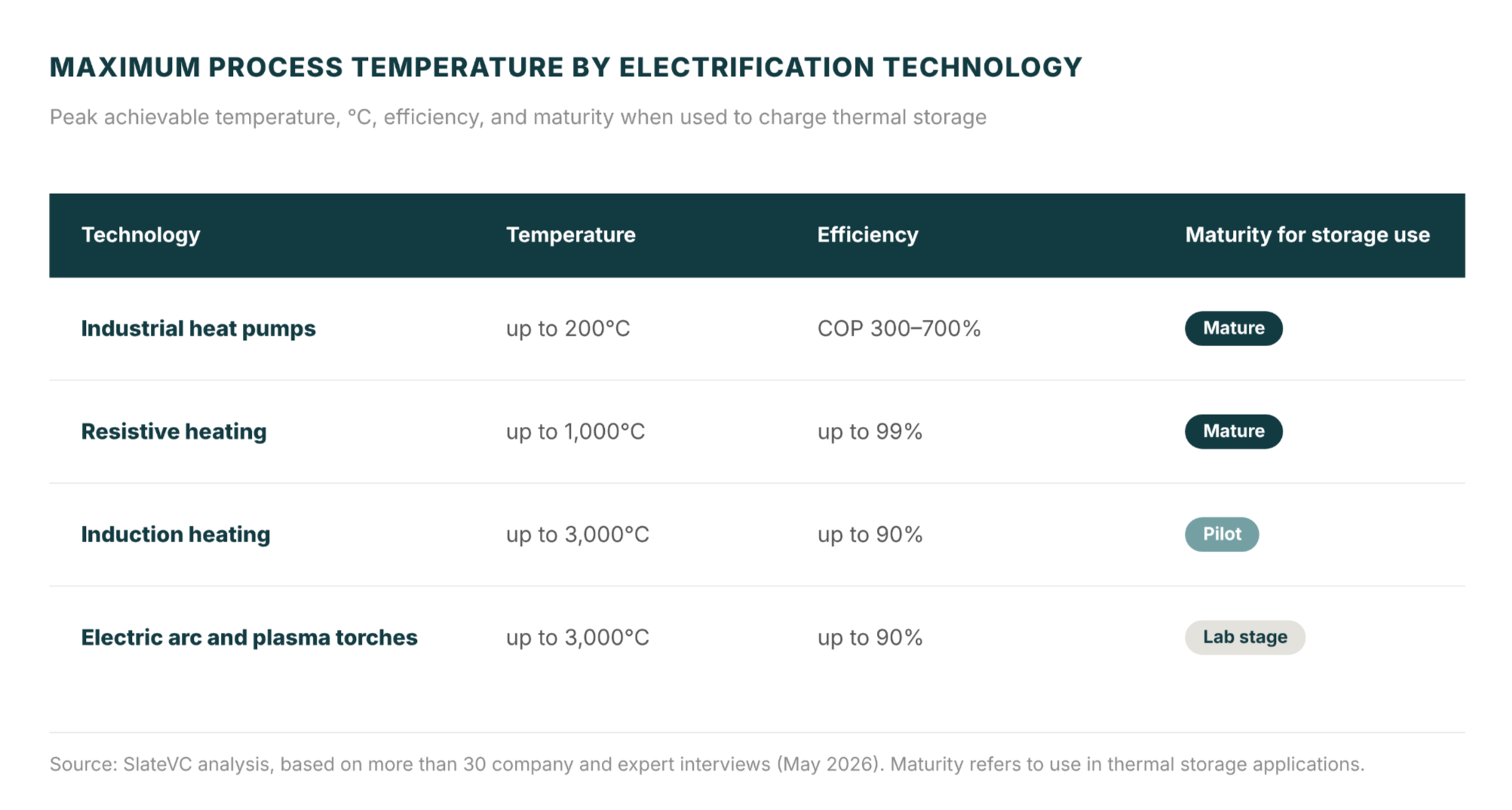
Four direct electrification technologies currently address different parts of the temperature spectrum, and none of them covers all of it. Industrial heat pumps reach up to 200°C with performance coefficients of 300% to 700%, and are highly mature. Resistance-based heating reaches up to 1,000°C at up to 99% efficiency, though its efficiency declines at the highest temperatures. Induction heating reaches up to 3,000°C at up to 90% efficiency, offers fast, uniform, precisely controlled heating, and is now in pilot deployment for storage applications. Electric arc and plasma torches can reach temperatures up to 3,000°C and, in optimised designs, achieve thermal efficiencies of up to about 90%. They are well-established for industrial applications such as cutting, welding and material processing. However, their use in energy-storage applications remains at the R&D stage, with electrode wear, power-electronics requirements and potential grid-flicker issues posing challenges to large-scale deployment[15].
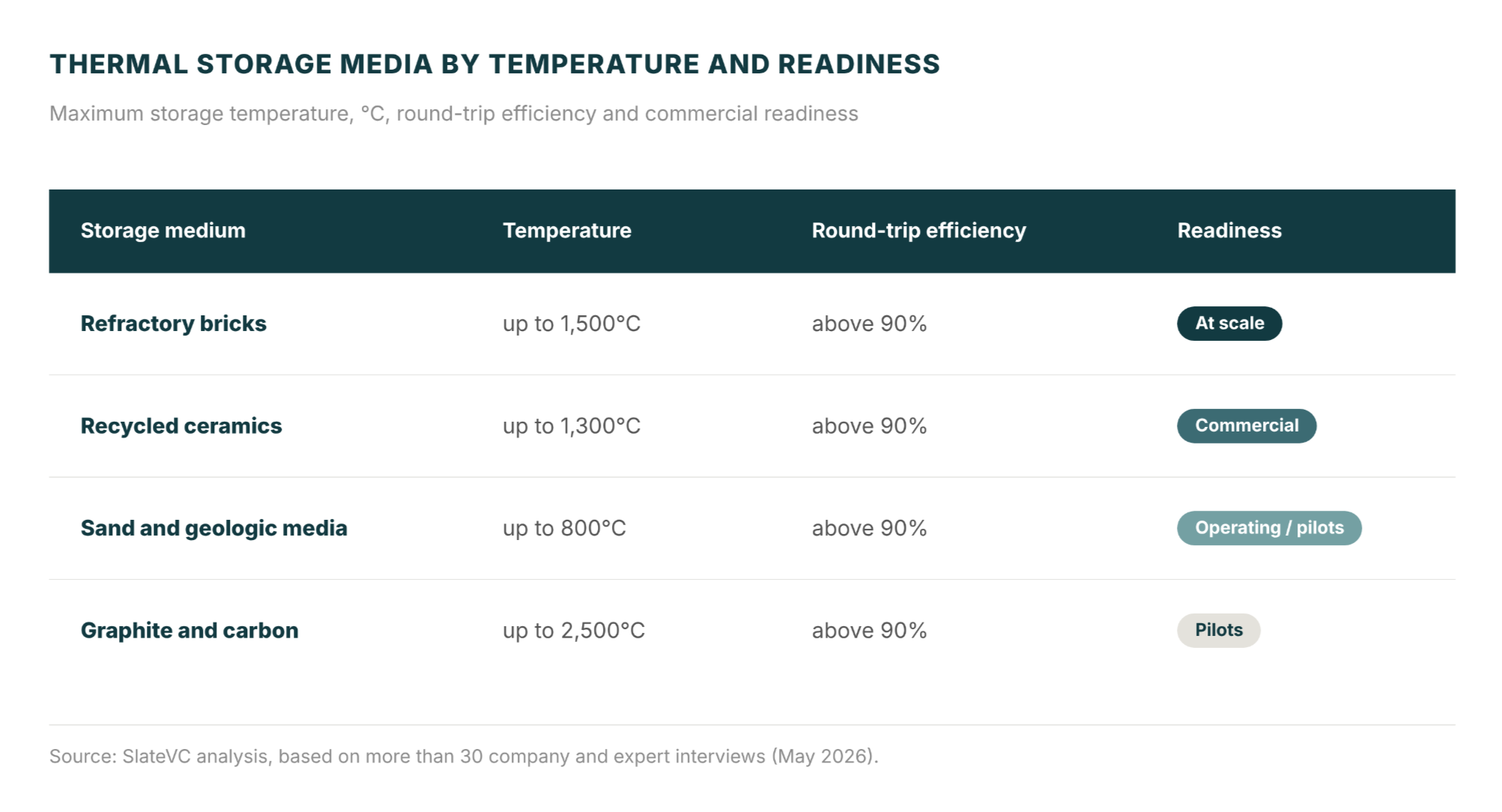
Storage follows a parallel logic, and clusters around four material families. Refractory bricks, drawing on decades of industrial heritage from Cowper stoves, reach up to 1,500°C at above 90% round-trip efficiency and are already operating at scale in steel, glass, cement and steam applications, though they carry a heavy structural footprint. Recycled ceramics reach up to 1,300°C at similar efficiency, are already operating commercially, and carry a sustainability advantage of their own, since they are typically produced from around 85% recycled slag. Sand and other geologic media reach up to 800°C at above 90% round-trip efficiency, are extremely low cost given the abundance of the underlying material and are already used in district heating and food and beverage applications, though their low thermal conductivity limits how quickly they can charge and discharge. Graphite and carbon-based storage reach the highest temperatures, up to 2,500°C, and the highest energy density of any of the four but remain at pilot stage and require an inert atmosphere to prevent oxidation[15].
What unites the two taxonomies is a simple mechanical relationship: storage is what lets an industrial site capture the value of intraday electricity price volatility. A resistance-based heating system without storage still exposes an operator to whatever the electricity price happens to be at the moment heat is needed. The same system paired with brick, ceramic or sand storage can charge during the growing number of low or negative-price hours and discharge on demand, turning a source of operational risk into a source of margin. This is why the two technology stacks, generation and storage, cannot be evaluated separately, and why the combination, more than either element in isolation, is where the real engineering and commercial innovation is concentrated.
[.green-box]Section 04[.green-box]
From hardware sales to Heat-as-a-Service
Even a well-matched combination of generation and storage technology fails to convert into adoption if the customer cannot afford it. Many industrial operators are cash-constrained and risk-averse: process heat sits at the centre of core manufacturing activity, and few finance teams will approve a large upfront capital outlay to replace equipment that already works, however volatile its running cost.
Two business models currently coexist, and they allocate capital, risk and integration complexity very differently. Under a traditional hardware sale, the customer owns the asset outright and pays upfront with no recurring revenue to the technology provider. The customer carries all integration and commodity trading risk itself, typically coordinating between an equipment manufacturer and a separate engineering, procurement and construction contractor. Under a Heat-as-a-Service model, an asset company, financed by a mix of debt and equity, owns the equipment on the customer’s site. It bundles development, assembly, engineering, energy management software and financing into a single offer, and is paid through a recurring contract that mixes fixed and variable payments. Electricity trading, where the operator actively times consumption to capture low and negative-price windows, is included in the Heat-as-a-Service offer, though how its value is shared is set by the contract. Under a hardware sale it is at best sold on top, and the trading risk stays with the customer or a third-party provider.
The Heat-as-a-Service business model removes the two biggest barriers to industrial adoption at once: the upfront capital outlay, and the operational complexity of managing and piloting a new energy asset alongside a core manufacturing process.
Hybridisation, retaining the existing gas boiler as a backup rather than replacing it outright, offers a further way to de-risk the transition for customers unwilling to accept any disruption to processes they cannot afford to interrupt.
In practice, we expect to see business models varying case by case between a pure hardware sale and a full Heat-as-a-Service. For instance, some industrial companies want to own all assets in their factories while not having the capability to manage real-time gas/electricity optimisation.
[.green-box]Section 05[.green-box]
Where we see the opportunity
Given a market this large, this fossil-dependent and this exposed to converging regulatory and price pressure, the investment question is not whether industrial heat electrifies, but which combinations of technology, temperature range and business model reach commercial scale first, and in what order.
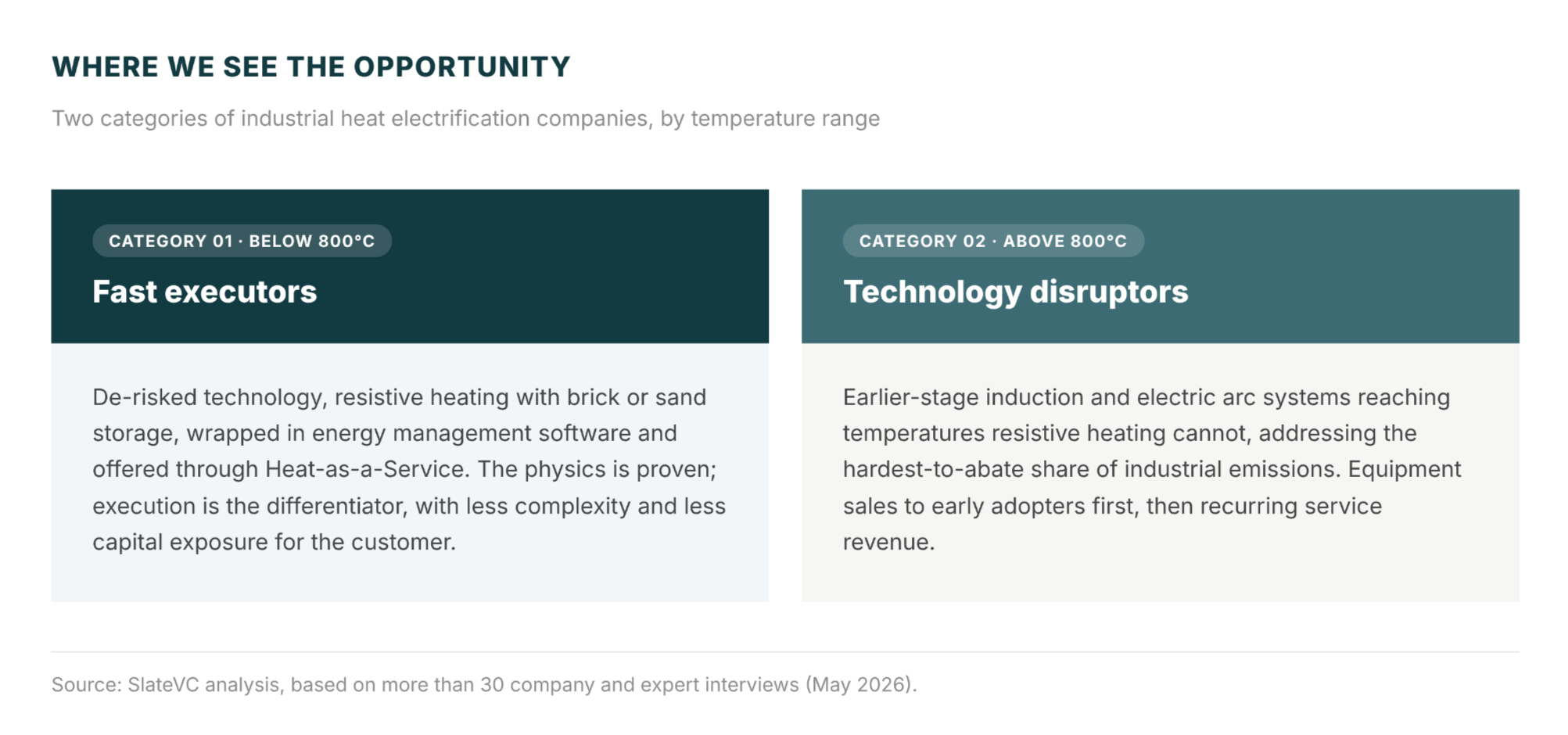
We organise the opportunity around two broad categories.
The first, which we call fast executors, targets low and mid-temperature heat below roughly 800°C using de-risked technologies such as resistance-based heating paired with bricks, ceramics, or sand storage, wrapped in integrated energy management software and offered through Heat-as-a-Service alongside traditional hardware sales. As the underlying physics is largely proven, what separates them is their ability to reduce execution complexity and capital exposure for industrial customers who need to adopt quickly and without disruption.
The second category, technology disruptors, targets the harder, higher-temperature segment above 800°C, the hardest-to-abate share of industrial emissions. Using earlier-stage technologies such as induction heating, they can reach temperatures resistance-based heating cannot. These businesses typically sell equipment to early industrial adopters first, building toward recurring revenue through long-term service contracts and, over time, a Heat-as-a-Service pathway of their own.
We expect industrial heat to electrify. The key question for us is which combinations of technology, temperature range and business model will reach commercial scale first.
Industrial heat sits at an unusual point of alignment: a market large enough to matter, an emissions profile heavy enough to justify policy intervention, and a set of price and regulatory dynamics that make the economics of switching competitive or close to being. The technologies required to make that switch already exist in workable form for roughly half of the market, and are advancing quickly for the rest. What remains is largely a question of customer adoption and delivery: pairing the right generation technology with the right storage medium, and wrapping both in a financing model that a risk-averse industrial buyer can actually say yes to. We believe that is where the next several years of value creation in this sector will concentrate.
Authors
Sébastien Léger, General Partner
Chloé Giard, General Partner
Célia Bellec, Associate
Notes
- Final energy consumption by sector, EU-27: Eurostat (2024 data, published June 2026).
- Share of industrial process heat from fossil fuels: Fraunhofer ISI for Agora Industry, “Direct electrification of industrial process heat: An assessment of technologies, potentials and future prospects for the EU” (2024).
- Temperature breakdown of industrial process heat demand: Agora Industry, Agora Energiewende, Fraunhofer ISI, ECCO Think Tank and Reform Institut, “The business case for electrifying industrial heat. Evidence from selected EU Member States” (2026).
- EU industrial heat fuel spend: SlateVC estimate based on Eurostat industrial gas prices and EU industrial heat demand (European Commission Joint Research Centre, JRC-IDEES; Industry Heat-EU dataset).
- Global industrial heat equipment spend: Ambienta, Sustainability Lens I 2023, “Electrifying Industrial Heat”, Ambienta analysis on IEA data (2023).
- Thermal energy storage capacity and capital expenditure forecasts: McKinsey & Company, “Industrial heat electrification in Europe: New business models emerge” (13 March 2026).
- EU fossil fuel import bill and industrial energy prices compared with main trading partners: European Commission, 6th Report on Energy Prices and Costs in Europe, COM(2025) 72 (February 2025).
- Reduction in EU industrial gas use from electrifying heat: IEA, “Renewables for Industry: Electrification of low-temperature heat and steam” (2025).
- European natural gas price: Dutch TTF front-month contract, ICE Endex, via Trading Economics (October 2026).
- Share of wind and solar and of renewables in global electricity generation: Ember, Global Electricity Review 2026 (April 2026) and Yearly Electricity Data.
- Carbon intensity of EU electricity, about 170 g CO₂ per kWh: IEA, Electricity 2026. Natural gas, about 200 g CO₂ per kWh of fuel burned: IPCC default emission factor, 56.1 t CO₂ per TJ.
- Share of hours in which electricity was cheaper than gas, France, April 2019 and April 2025: Epyr, “How Epyr began: A story of steam, electrons and bricks” (2025).
- Growth of Europe’s demand-side flexibility market: McKinsey & Company, “Unlocking Europe’s €8 billion energy flexibility opportunity” (16 October 2025).
- Regulatory timeline:
European Commission, proposal for an Industrial Accelerator Act, COM(2026) 100, 4 March 2026.
European Commission, Electrification Action Plan, 17 July 2026.
European Commission, Innovation Fund Heat Auction (IF26), terms and conditions, June 2026.
Regulation (EU) 2026/667 amending the European Climate Law, adopted by the Council on 5 March 2026 and published in the Official Journal on 18 March 2026. - Temperature range, efficiency and maturity of electrification and storage technologies: SlateVC analysis, based on more than 30 interviews with companies and industry experts across the value chain, as of May 2026.
Principal Sources
The analysis in this article draws principally on the following sources: Eurostat, European energy statistics; European Commission Joint Research Centre; Agora Industry and the Fraunhofer Institute for Systems and Innovation Research (ISI); Ambienta (2023); IEA, Electricity 2026; Ember, Global Electricity Review 2026 and Yearly Electricity Data; IPCC 2006 Guidelines; European Commission, 6th Report on Energy Prices & Costs in Europe (2025); McKinsey & Company; EEX intraday electricity price data; ICE Endex / Trading Economics; European Commission and Council of the European Union legislative materials on the Industrial Accelerator Act, the Electrification Action Plan, the Innovation Fund Heat Auction and the European Climate Law; and SlateVC proprietary analysis, informed by more than 30 interviews with companies and industry experts across the value chain.
SlateVC — 5 Avenue de l'Opéra, 75001 Paris, France · slate.vc